AI-generated ads people don't scroll past
How to make AI-generated ads that stop the scroll: one product kept exact, six ad jobs, a prompt for each frame, feed and story layouts, and what to test.

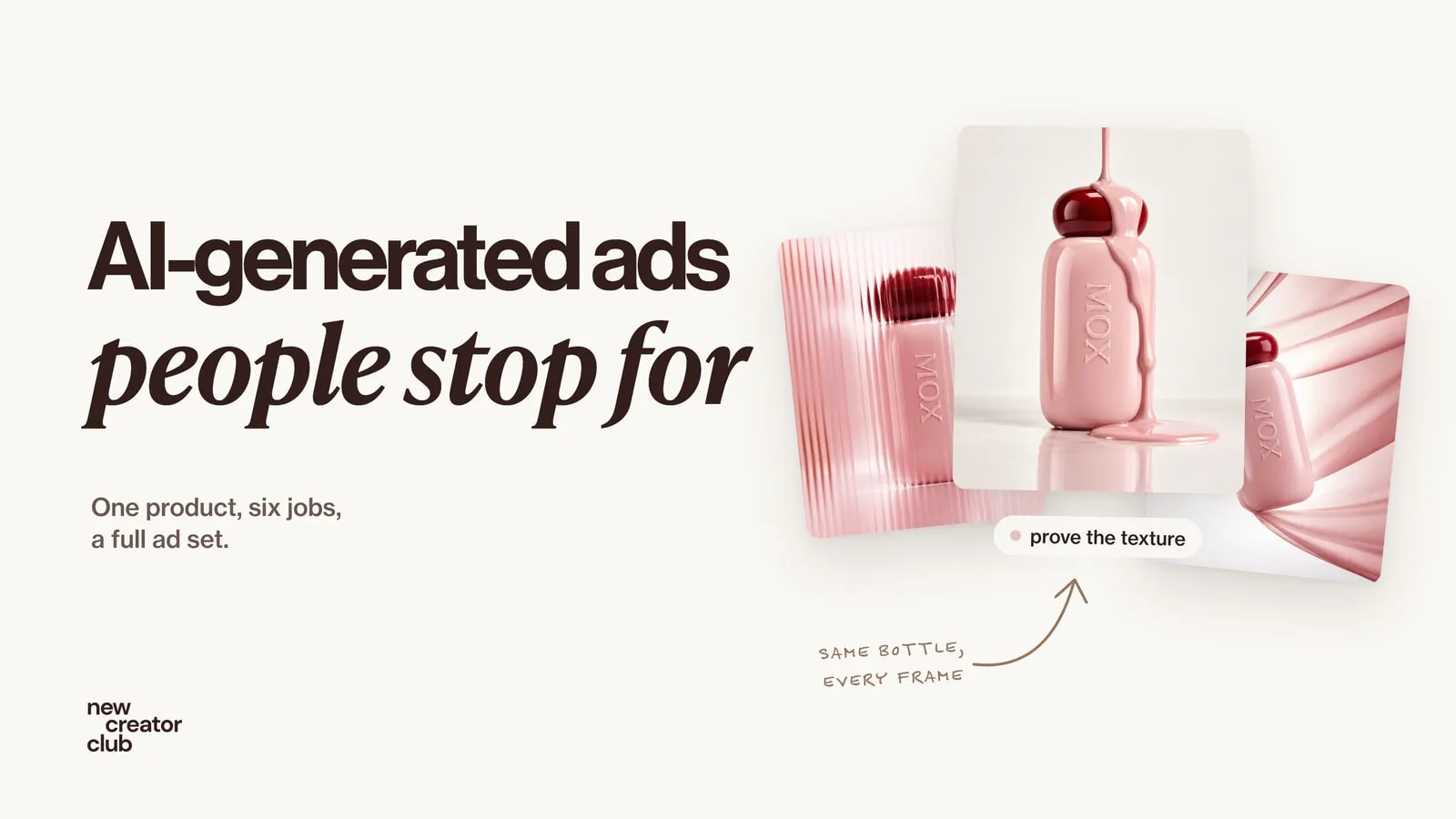
AI-generated ads are adverts whose images or video are made with AI tools instead of a photo shoot. The ones that work keep the real product exactly as it is, give every image one job (stop the scroll, show the product, prove the texture, show the scale, sell the feeling), are built for the placement they run in, and are tested against each other one change at a time.
Plenty of people say they hate AI-generated ads, and they have a point: most of them look like the same glossy stock scene with a product pasted in. The problem isn't AI. It's ads with no idea, a product that quietly changes shape, and an image that wasn't made for the place it runs. This guide builds a full ad set for one invented beauty product, MOX body lotion, and shows the prompt behind every frame, how each one becomes an ad, and what to test.
What makes an AI-generated ad work
Four things separate the ads people stop for from the ones they skip:
- The product stays exact. Same shape, colour, cap and lettering in every frame. Buyers notice when it changes, even if they can't say why.
- Each image has one job. An ad that tries to show the product, the texture and the lifestyle at once does none of them.
- There is an idea. A bottle behind ribbed glass or lotion pouring over the cap is something a person remembers. A bottle on marble is not.
- It's made for the placement. A feed ad, a story and a teaser need different framing and different amounts of text.
Start with the product sentence
Before any scene, describe the product in one precise sentence and paste it word for word into every prompt, with a clean photo of the product attached as a reference. Ours:
A small, rounded, pill-shaped bottle of body lotion in glossy pastel pink, the letters "MOX" embossed vertically down the front in a tall, thin serif, tone on tone, with a domed, high-gloss cherry-red cap.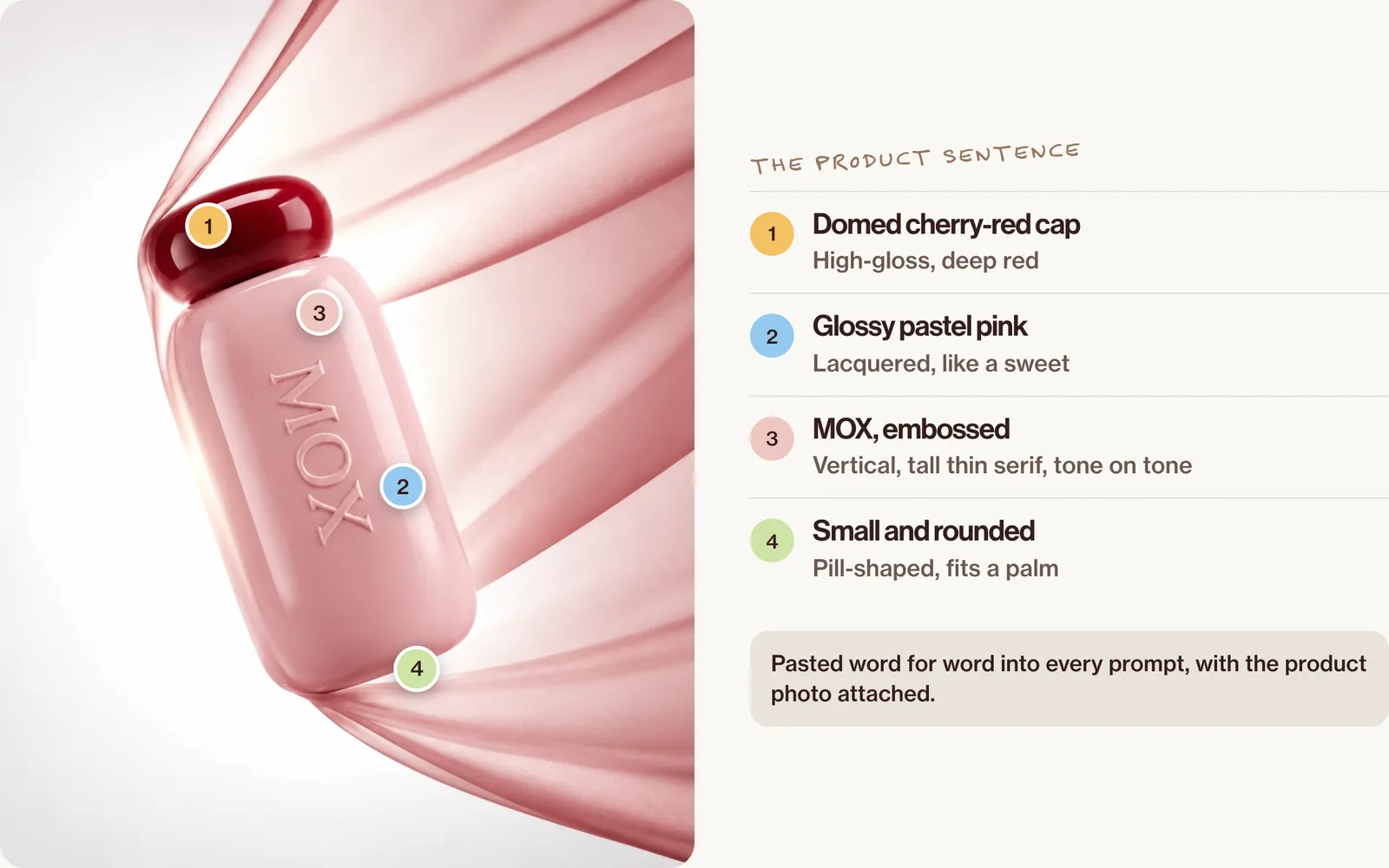
If you sell a real product, photograph it first: front, side and back, in daylight. AI product photography covers that step in detail.
Six jobs an ad set has to do
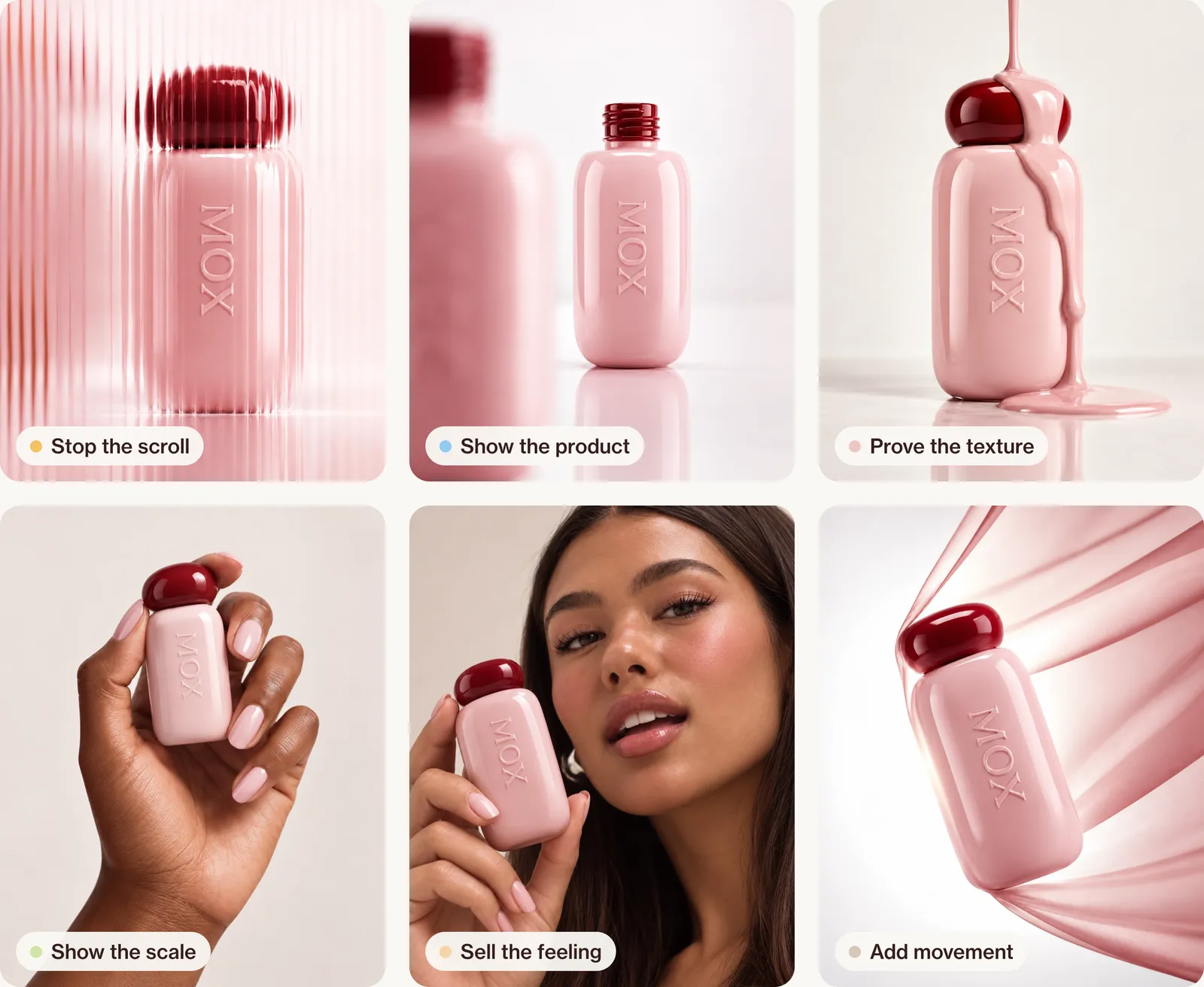
Plan the set before you prompt. One frame per job, and you know which ad each frame is for:
| Job | The frame | Best placement |
|---|---|---|
| Stop the scroll | The bottle behind ribbed glass | Feed and stories, first in a carousel |
| Show the product | The bottle open on white | Product ads, catalogue, retargeting |
| Prove the texture | Lotion pouring over the cap | Feed, the second card of a carousel |
| Show the scale | The bottle held in a hand | Feed, product pages |
| Sell the feeling | A model holding it to her cheek | Stories and reels covers |
| Add movement | The bottle wrapped in sheer fabric | Stories, and the start of a short video |
Put together, the same frames work as one carousel ad. Lead with the hook and end with the product, so the last card is the one people buy from.
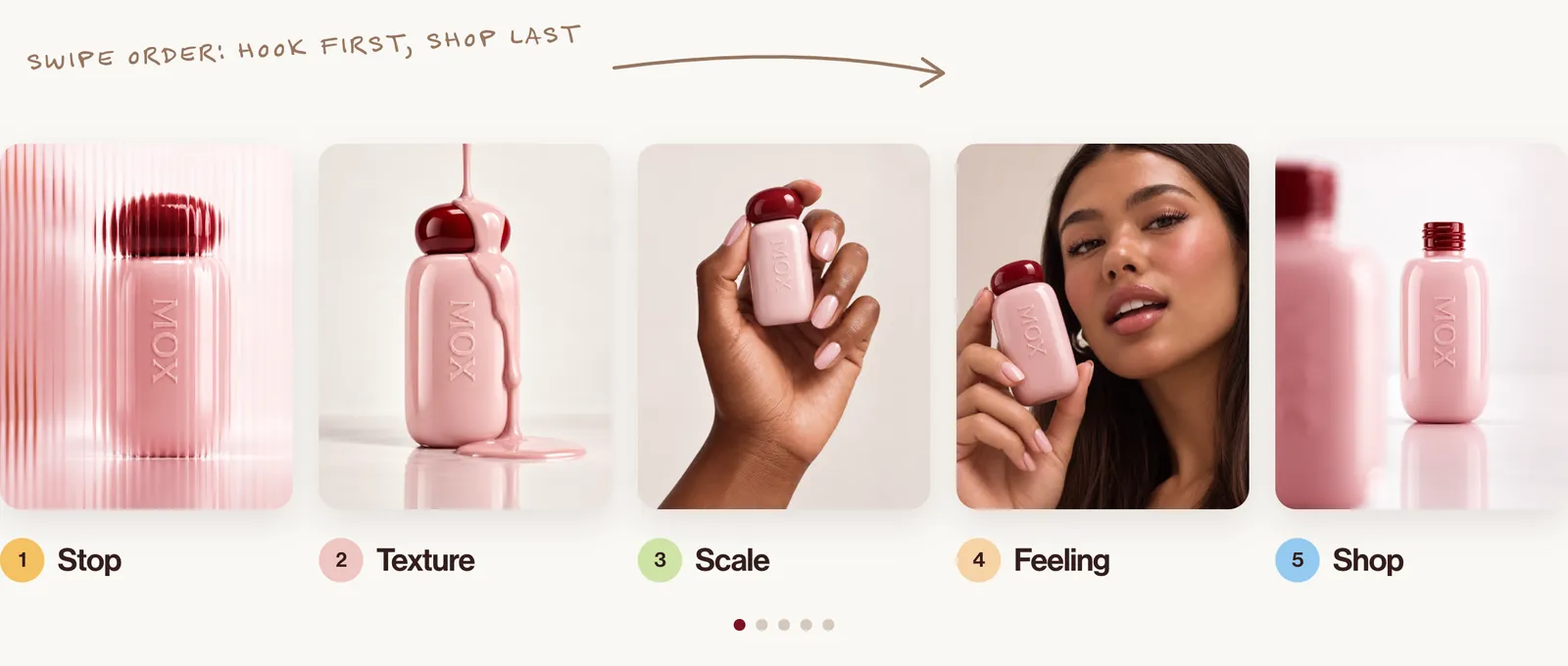
The prompts, frame by frame
Every prompt follows the same eight decisions (explained in AI image prompts that look like real photos): creative direction, art direction, material, palette, lighting, photography, mood and post-processing. Only the idea changes from frame to frame; the product sentence never does. Attach the product reference to each one.
1. Stop the scroll: behind ribbed glass
Creative direction: a scroll-stopping frame for a beauty launch, more design than photograph, the kind of image people pause on before they know what it's for. Art direction: the bottle standing centred behind a sheet of vertically ribbed glass that fills the whole frame, so the bottle breaks into soft vertical stripes while the "MOX" letters still read through the glass; a glossy surface reflects it below. The bottle is a small, rounded, pill-shaped bottle of body lotion in glossy pastel pink, the letters "MOX" embossed vertically down the front in a tall, thin serif, tone on tone, with a domed, high-gloss cherry-red cap. Material: clear fluted glass with crisp ridges, lacquered pink plastic, a mirror-like base. Palette: all pink, from blush to rose, with the cherry-red cap as the only strong accent. Lighting: bright, even studio light from the front and a soft glow from behind the glass. Photography: straight-on, 100mm look, the glass ridges sharp, vertical 4:5. Mood: dreamy, graphic, curious. Post-processing: true colour, crisp ridges, no haze.2. Show the product: open, on white
Creative direction: the hero frame of a skincare campaign, the product alone, clean and confident. Art direction: the bottle standing open on a glossy white surface with its cap off, showing the ridged cherry-red neck; a second bottle stands close to the lens on the left, deliberately out of focus, framing the shot. The bottle is a small, rounded, pill-shaped bottle of body lotion in glossy pastel pink, the letters "MOX" embossed vertically down the front in a tall, thin serif, tone on tone, with a domed, high-gloss cherry-red cap. Material: high-gloss lacquered plastic, the embossed letters catching the light, a long mirror reflection in the white surface. Palette: pastel pink, cherry red, clean white. Lighting: bright studio light from the left, a clean highlight down the curve of the bottle. Photography: 100mm look, the hero bottle sharp from neck to base, the foreground bottle a soft blur by design, vertical 4:5. Mood: fresh, simple, new. Post-processing: true colour, gloss highlights kept, no glow.3. Prove the texture: the pour
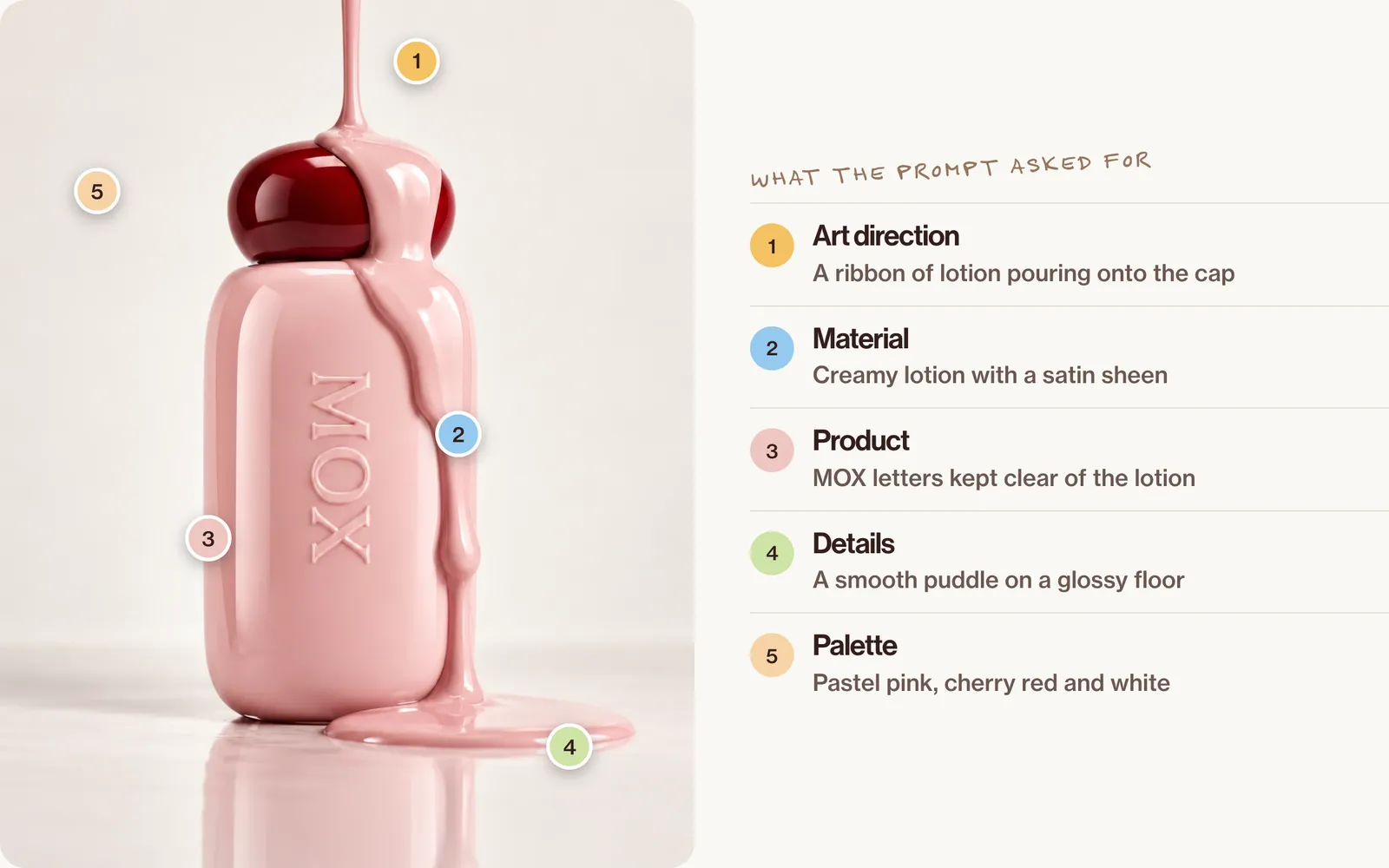
Creative direction: a texture shot for a body lotion ad, the frame that answers "what does it feel like". Art direction: a thick ribbon of pink lotion pouring from above onto the cherry-red cap, spilling over it, running down one side of the bottle in a single glossy stream and pooling in a smooth puddle on the surface; the "MOX" letters stay clear of the lotion. The bottle is a small, rounded, pill-shaped bottle of body lotion in glossy pastel pink, the letters "MOX" embossed vertically down the front in a tall, thin serif, tone on tone, with a domed, high-gloss cherry-red cap. Material: rich, creamy lotion with a satin sheen, the same pink as the bottle; lacquered plastic; a glossy white floor with a soft reflection. Palette: pastel pink, cherry red, white. Lighting: clean studio light from the upper left, a highlight running along the lotion stream. Photography: eye level, 100mm look, the bottle and the pour sharp, vertical 4:5. Mood: indulgent, smooth, a little playful. Post-processing: true colour, no glow, no smoothing of the lotion's texture.4. Show the scale: in a hand
Creative direction: a scale shot for a beauty ad, so the viewer knows exactly how big the bottle is. Art direction: a hand with deep brown skin and short almond nails painted the same pale pink as the bottle, holding it up between the fingers and thumb, the cap at the top, against a plain warm-grey wall. The bottle is a small, rounded, pill-shaped bottle of body lotion in glossy pastel pink, the letters "MOX" embossed vertically down the front in a tall, thin serif, tone on tone, with a domed, high-gloss cherry-red cap. Material: real skin with knuckle creases and fine lines, glossy nail polish, lacquered plastic. Palette: warm grey, deep brown skin, pastel pink, cherry red. Lighting: soft directional studio light from the upper left, a gentle shadow under the fingers. Photography: 85mm look at f/8, the hand and bottle sharp, vertical 4:5. Mood: elegant, easy, human. Post-processing: true colour, unretouched skin.5. Sell the feeling: on a model
Creative direction: a beauty campaign portrait that sells how the product makes you feel, not what it is. Art direction: a woman in her twenties with long dark brown hair, holding the bottle up to her cheek with the label towards the camera, lips slightly parted, looking straight into the lens; a gold hoop earring, pale pink nails matching the bottle. The bottle is a small, rounded, pill-shaped bottle of body lotion in glossy pastel pink, the letters "MOX" embossed vertically down the front in a tall, thin serif, tone on tone, with a domed, high-gloss cherry-red cap. Material: glowing skin with its fine texture still visible, a sheen on the cheekbones, glossy lips, fine flyaway hairs. Palette: warm beige backdrop, golden skin, pastel pink, cherry red. Lighting: warm studio light from the front left, soft shadow along the jaw. Photography: close-up, 85mm look at f/5.6, her face and the bottle both sharp, vertical 4:5. Mood: warm, confident, close. Post-processing: true colour, a polished beauty finish without smoothing the skin away.6. Add movement: sheer fabric
Creative direction: a frame with motion in it, for stories and the first second of a short video. Art direction: the bottle tilted on a diagonal in mid-air, a long sweep of sheer pink chiffon curving around and behind it as if caught by a breeze, the fabric trailing off both edges of the frame. The bottle is a small, rounded, pill-shaped bottle of body lotion in glossy pastel pink, the letters "MOX" embossed vertically down the front in a tall, thin serif, tone on tone, with a domed, high-gloss cherry-red cap. Material: translucent chiffon with fine folds, lacquered plastic. Palette: white, pastel pink, rose, cherry red. Lighting: bright backlight shining through the fabric, the bottle lit cleanly from the front. Photography: 85mm look, the bottle sharp, the fabric crisp at its edges, vertical 4:5. Mood: light, airy, in motion. Post-processing: true colour, no glow, no haze.To turn this frame into a short clip, keep the motion simple: the fabric drifts and the bottle turns a few degrees. AI UGC ads has a motion prompt you can adapt.
From image to ad
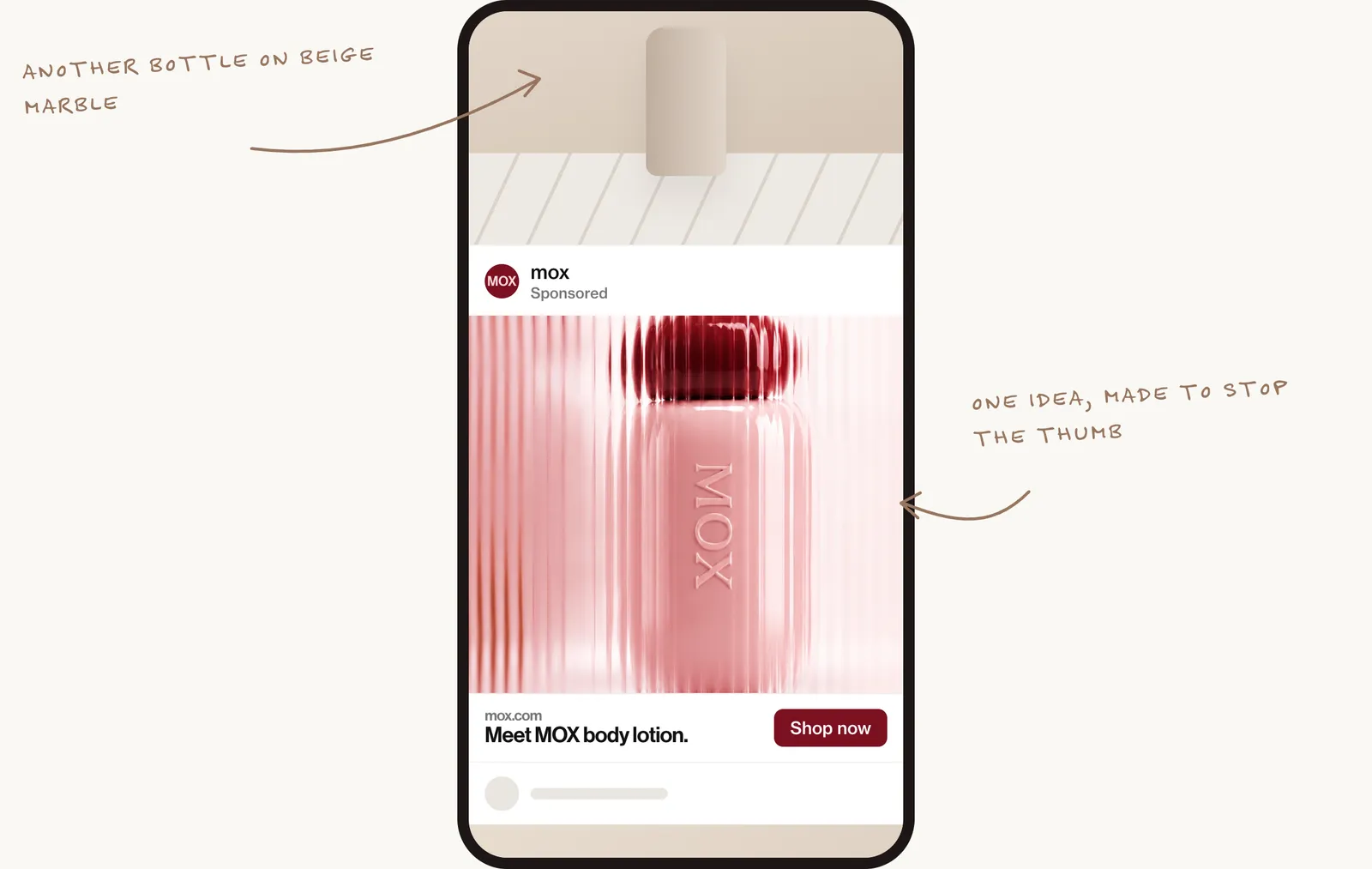
A frame isn't an ad until it has a layout made for where it runs. Three rules cover most of it:
- Few words. A headline of five words or fewer, plus the brand and one call to action.
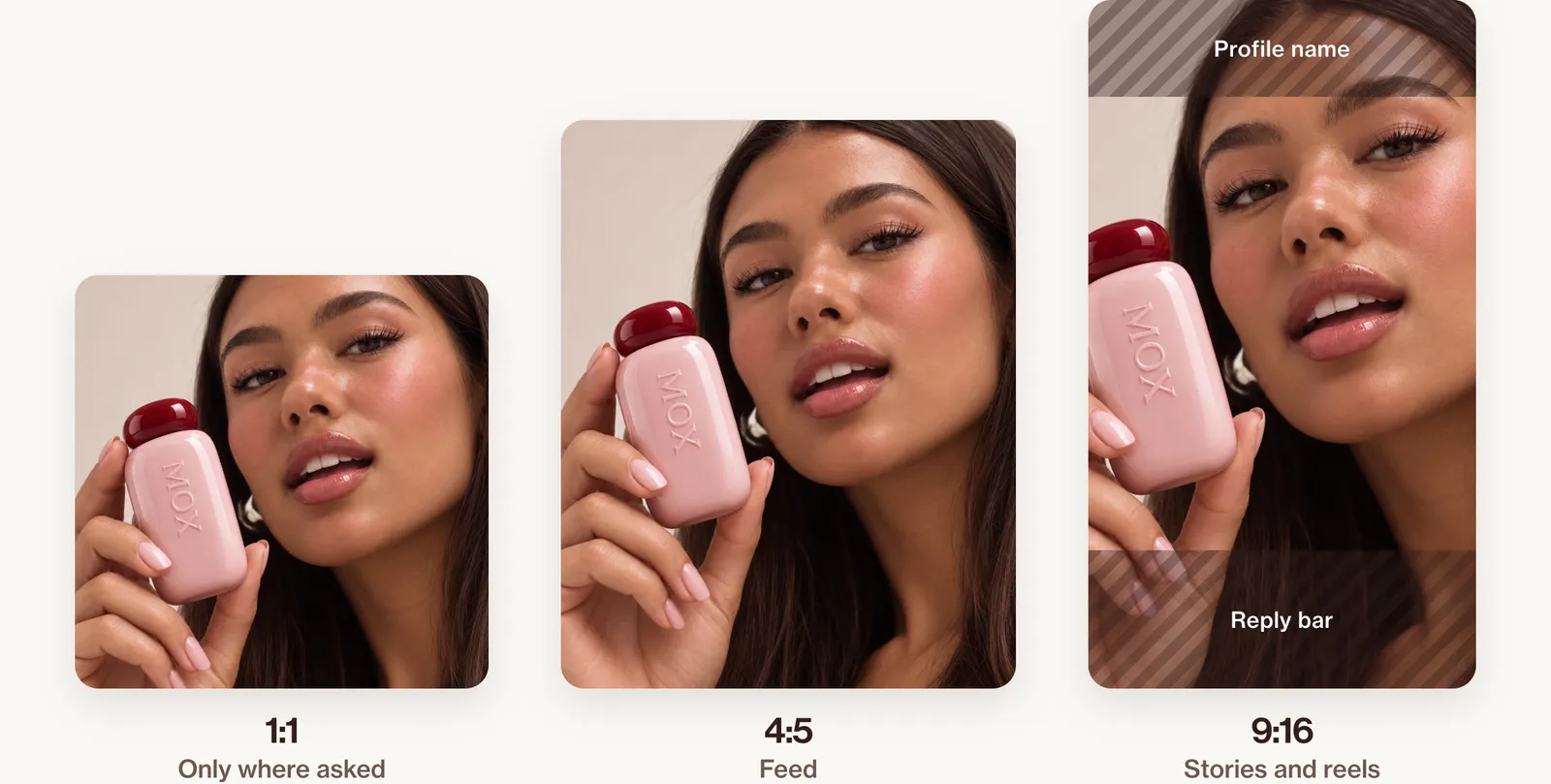
- Keep text in the safe zone. In stories, the profile name covers the top of the screen and the reply bar covers the bottom, so keep text and stickers between them.
- Use the right shape. 4:5 for feed ads, 9:16 for stories and reels, 1:1 only where a placement asks for it. Generate in the shape you need rather than cropping later.
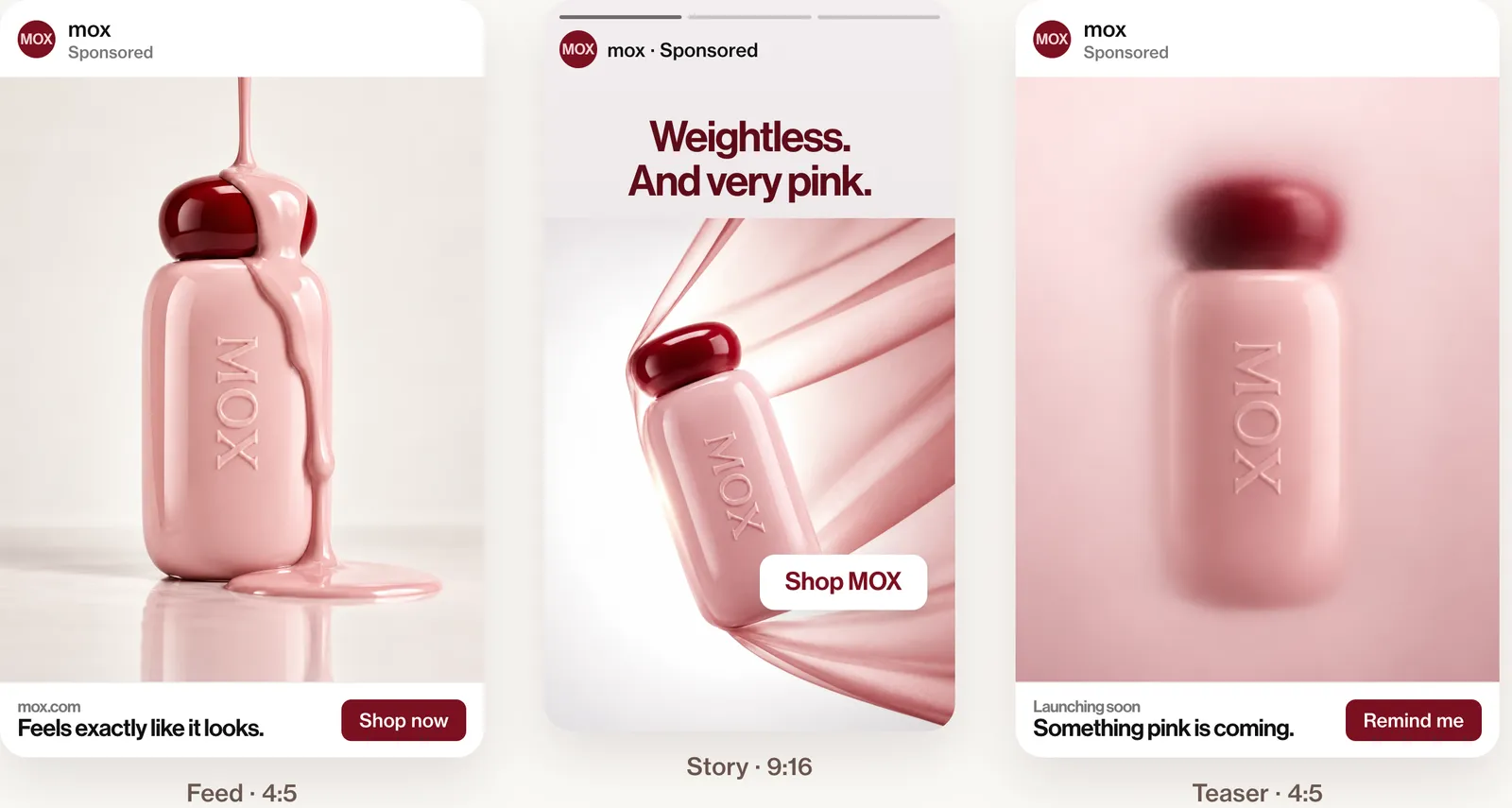
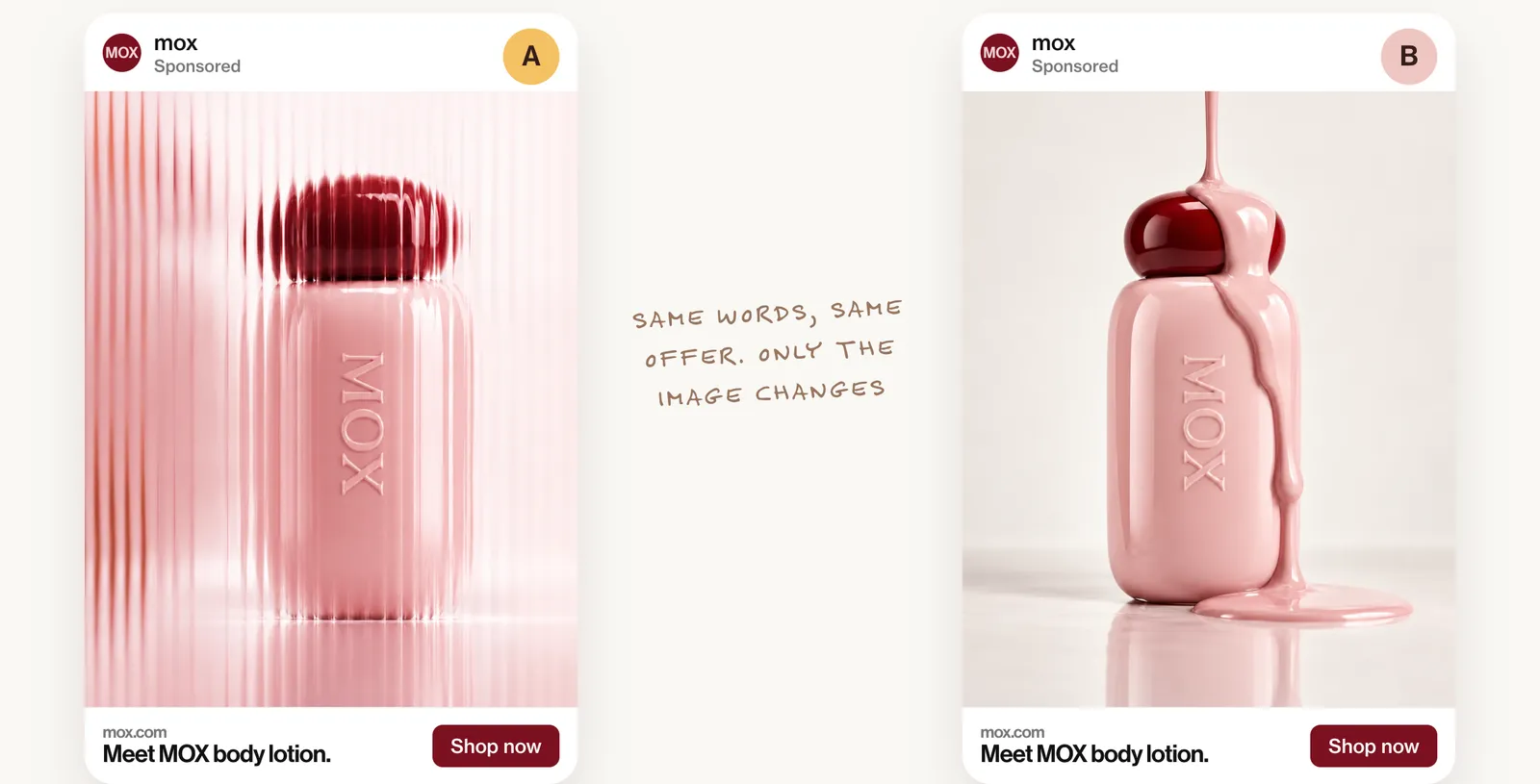
In feed ads the headline usually sits under the image, so the picture can stay clean. The teaser on the right is the one frame made blurry on purpose: soft focus hides the details until launch day. Everywhere else, keep the product sharp.
Test like an advertiser
AI makes variations cheap, so test properly instead of guessing. Change one thing at a time and run each version long enough to compare.
| Test | Keep the same | Change |
|---|---|---|
| Which idea stops the scroll | Headline, offer, audience | The image: ribbed glass vs the pour |
| Which headline sells | Image, offer, audience | The words |
| Product or person | Headline, offer | The bottle alone vs the model |
| Feed or story | Image and words | The shape and layout |
Compare cost per click and cost per purchase, not likes. And keep the frames that win: they tell you what your next set should look like.
Where AI-generated ads go wrong
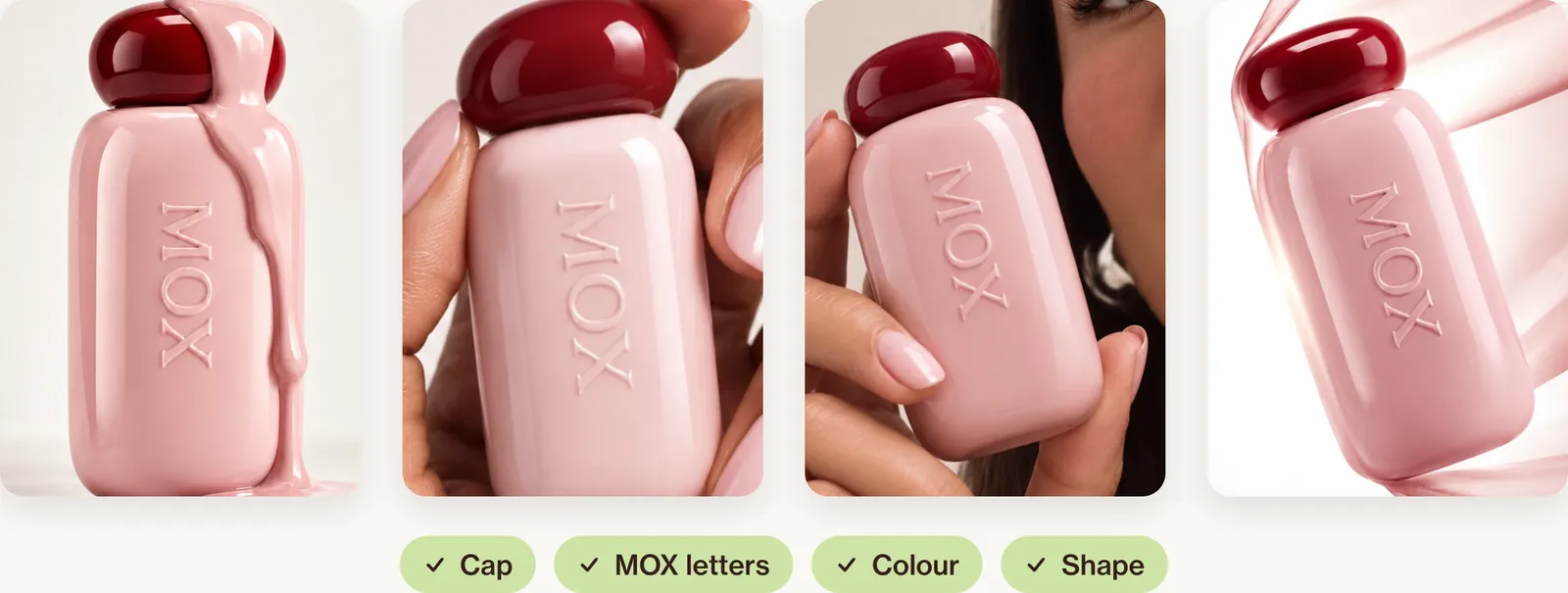
- The product drifts. Letters change, the cap gets a new shape, the colour shifts. Check every frame against the real product before it runs.
- Physics that can't happen. Liquid that defies gravity or fabric with no weight looks fake. Keep pours and fabric believable.
- Skin that's too perfect. Poreless skin is the quickest AI giveaway. See how to fix plastic skin.
- The same look as everyone else. Generic marble and soft beige make any ad look AI-made. One clear idea per frame is the fix; how to make AI photos look real lists the other tells.
- Claims the product can't back up. AI makes the picture. It doesn't make a claim true.
The quickest check is to crop the product out of every frame and line the crops up side by side:
Do you have to label AI-generated ads?
Often, yes. Meta adds an "AI info" label to ads made or heavily edited with AI, and TikTok asks advertisers to declare AI-generated content when they set up an ad. An AI-generated model should never be presented as a real customer. The rules are summed up in AI UGC ads; check each platform's own pages before you launch.
FAQ
What are AI-generated ads?
Adverts whose images, video or voice are made with AI tools instead of a photo or video shoot, usually starting from a photo of the real product.
How do I make AI-generated ads?
Photograph the product, write one product sentence, plan one frame per ad job, prompt each frame with the product attached, then lay each frame out for its placement and test the versions against each other.
Are AI-generated ads allowed on Facebook and Instagram?
Yes. Meta allows them and may add an "AI info" label. You still need to follow its advertising standards and disclose realistic AI content, especially of people.
Can I make AI-generated ads for free?
You can test ideas on free tiers of most image tools, but regular ad production usually needs a paid plan. Prices and limits change often.
Do AI-generated ads work?
They can, when the product is shown accurately and each image has a clear job. Test them against your current ads and judge by cost per purchase.
Go further
The ads people scroll past all look the same, and the ones they stop for start with an idea. Inside New Creator Club you learn to turn one product into a full set of ads, with the leading AI tools, from the first image to the finished video. Start creating.
Keep reading
AI product photography: one packshot, a full studio shoot
AI product photography from one packshot: a full studio shoot that keeps the label and colours true, with a worked example, the prompts and the checks.
AI UGC ads that look real (and stay honest)
How to make AI UGC ads that feel like real phone videos: script, camera look, avatar or creator, B-roll and edit, plus where AI fails and what to disclose.
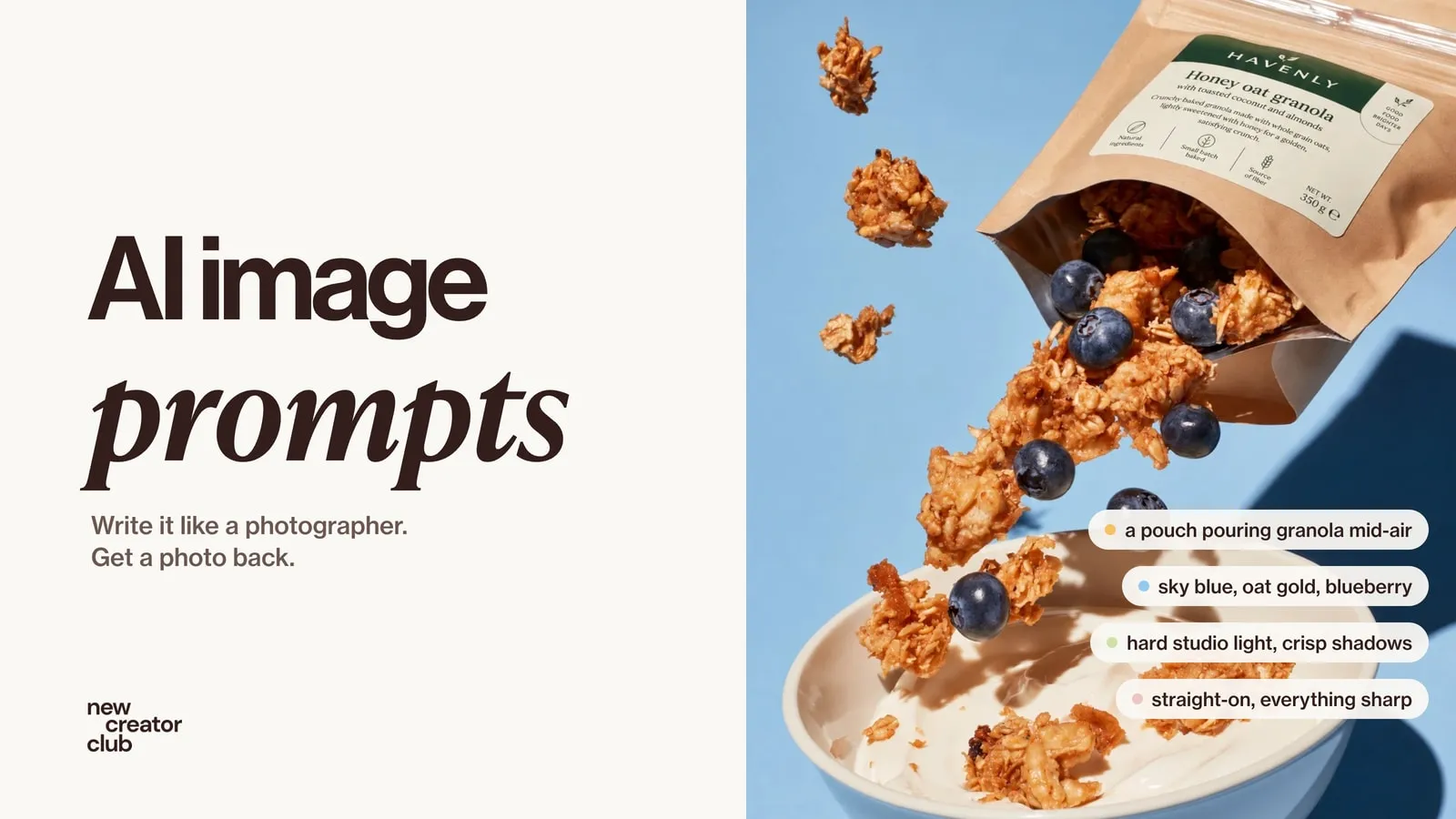
AI image prompts that look like real photos
Write AI image prompts that read like real photographs: an eight-part formula, with original prompts for portraits, products, UGC and editorial.