AI image prompts that look like real photos
Write AI image prompts that read like real photographs: an eight-part formula, with original prompts for portraits, products, UGC and editorial.

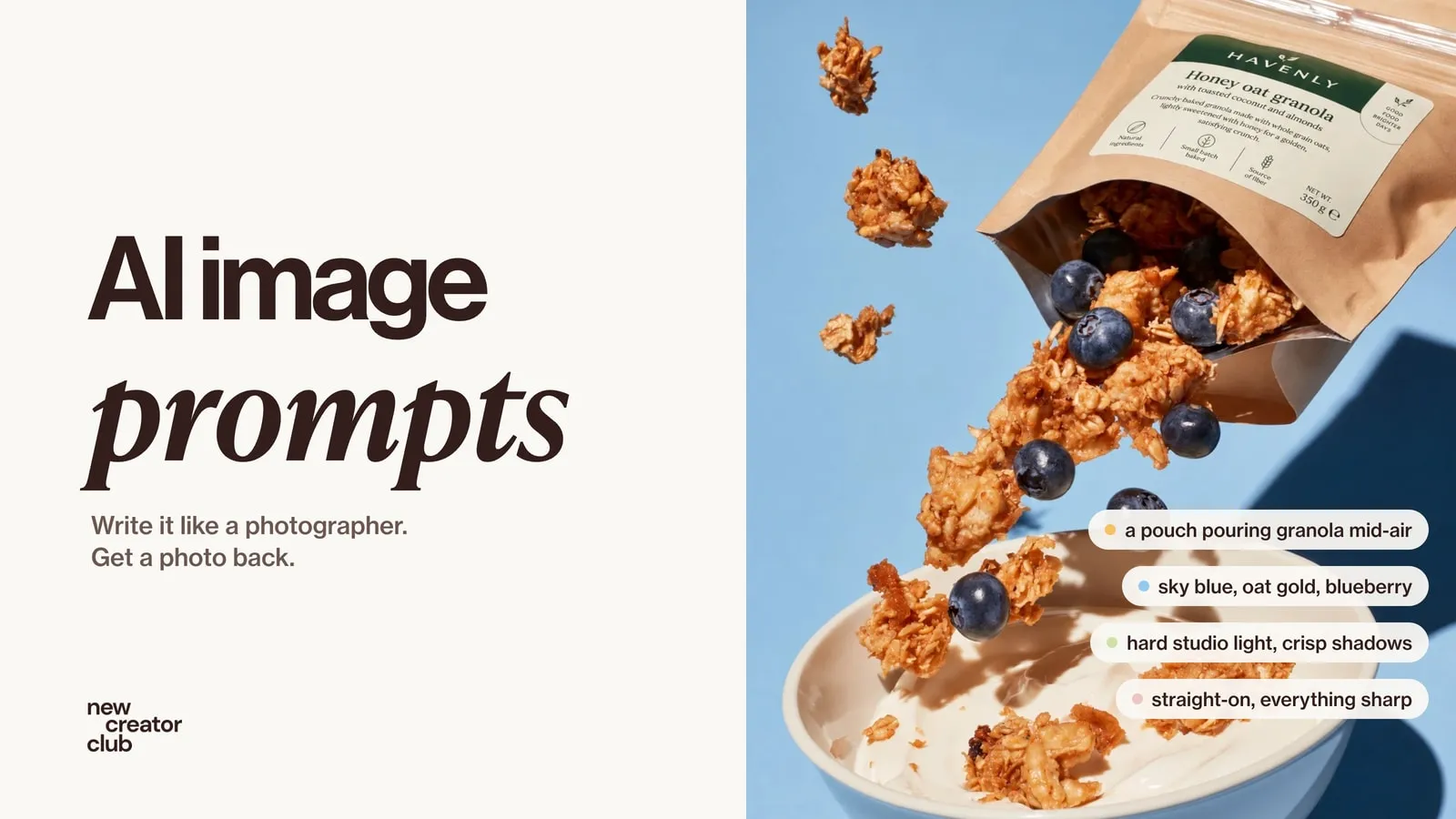
An AI image prompt is a written brief for a picture. For results that look like photographs rather than AI art, describe a real shoot: what the image is for, what happens in the frame, the subject and its materials, a small palette, where the light comes from, the camera and framing, the mood and the finish.
Most AI image prompts are lists of adjectives: "beautiful, cinematic, ultra-realistic, 8K, masterpiece". The model reads that as "make it look like everything else". Prompts that give you photographs read differently: like a photographer's plan for a shoot. This guide gives you that plan as eight decisions, a template to copy, and worked examples for portraits, products, lifestyle, phone-style UGC and editorial images.
What makes an AI image prompt work?
An image prompt is a brief. Everything you decide, the model follows; everything you leave out, it fills with its most typical choice. That is why short, vague prompts all come back looking alike, and why piling on quality words doesn't help. They describe a finish, not a photograph.
A prompt that works reads like a shot list: what the picture is for, what's in it, where the light is, where the camera stands and how it should feel.
The formula: eight decisions, in this order
Every prompt in this blog is written in the same order. It starts with the big idea and ends with the finish, so each line narrows the one before it.
| Decision | What to decide | Weak | Strong |
|---|---|---|---|
| Creative direction | What the image is for | "a nice photo" | "a hero image for a rosehip face oil's product page" |
| Art direction | What happens in the frame | "a bottle" | "the bottle half buried in a bed of glossy rosehips, shot from above" |
| Material | The subject and what it is made of | "skincare bottle" | "30 ml amber glass dropper bottle, matte black bulb, cream paper label" |
| Palette | A few colours | "colourful" | "rosehip red, deep orange, amber and black" |
| Lighting | Where the light comes from | "good lighting" | "hard midday sun, crisp shadows between the berries" |
| Photography | Lens, distance, framing, ratio | "high quality" | "straight down from above, 100mm lens, 4:5" |
| Mood | How it should feel | "aesthetic" | "rich, natural, confident" |
| Post-processing | The finish | "8K, ultra detailed" | "saturated but true colour, crisp detail, no glow" |
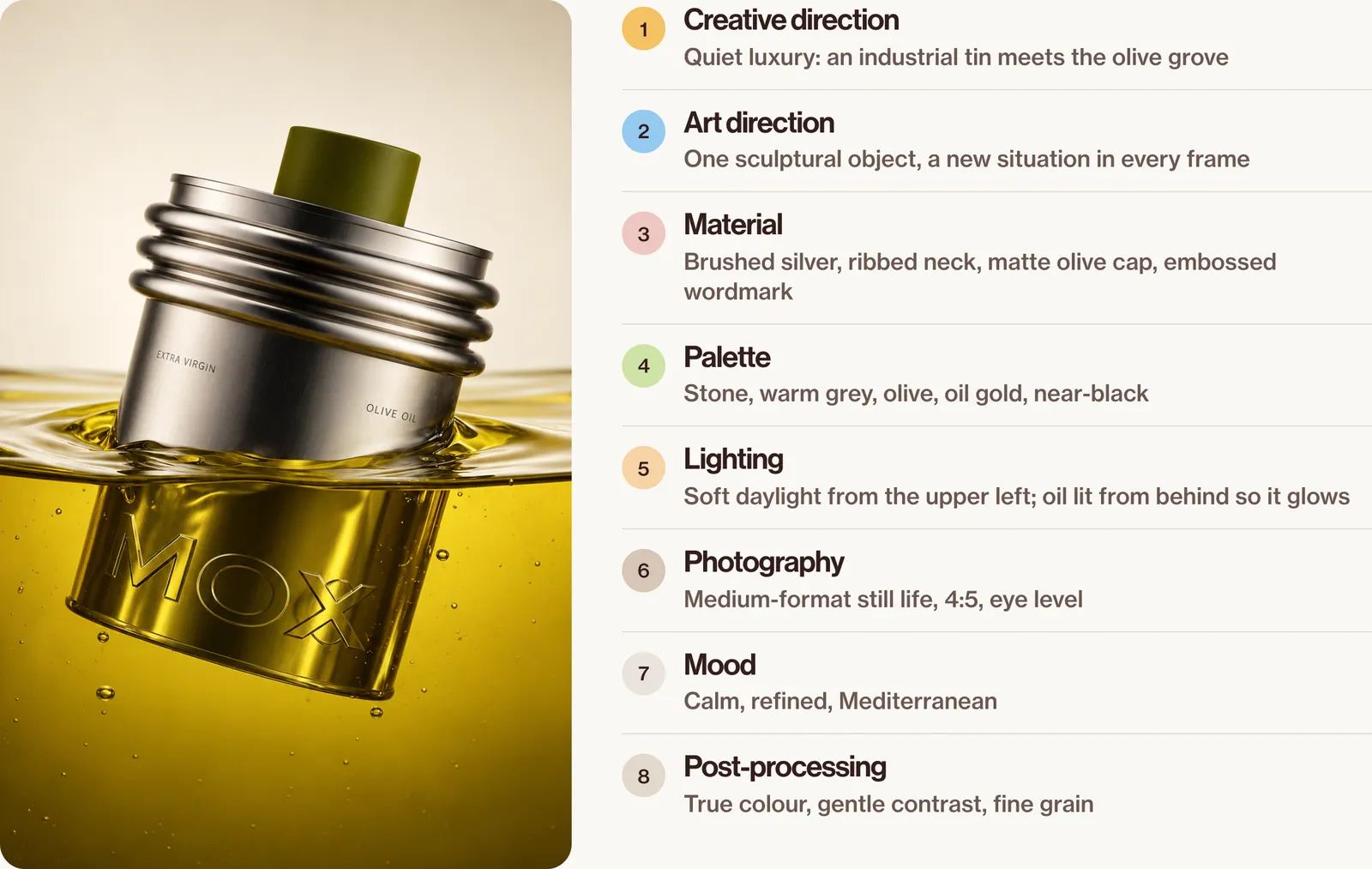
This is what eight clear decisions look like in a finished campaign frame. Every line is a choice, and nothing is left for the model to guess.
How the eight decisions map to "subject, setting, camera, light, style"
If you have seen the usual image prompt structure of subject, setting, camera, light and style, it is all here: subject is the material line, setting is art direction, camera is photography, light is lighting, and style is split into palette, mood and post-processing. The two extra decisions, creative direction and mood, are what stop an image looking generic.
What happens when you leave one out
Here is the full prompt. Try removing one line at a time and compare what comes back:
Creative direction: a playful hero image for an independent café's new menu, treating one cappuccino like a sculpture. Art direction: a single cappuccino in a handmade speckled cup balanced on top of a tall, slightly leaning stack of six mismatched saucers on a marble café table, one sugar cube resting on the rim of the top saucer. Product material: matte off-white stoneware with brown speckles and an uneven glazed rim, thick milk foam with a slightly broken leaf of latte art. Palette: cream, espresso brown, cool grey marble and one terracotta saucer. Lighting: low morning sun from a window on the right, the long crisp shadow of the stack falling across the marble. Photography: 50mm lens at f/4, straight-on at table height, 4:5 portrait, the cup sharp. Mood: quiet, witty, unhurried. Post-processing: natural colour, fine grain, foam bubbles and marble veins kept sharp.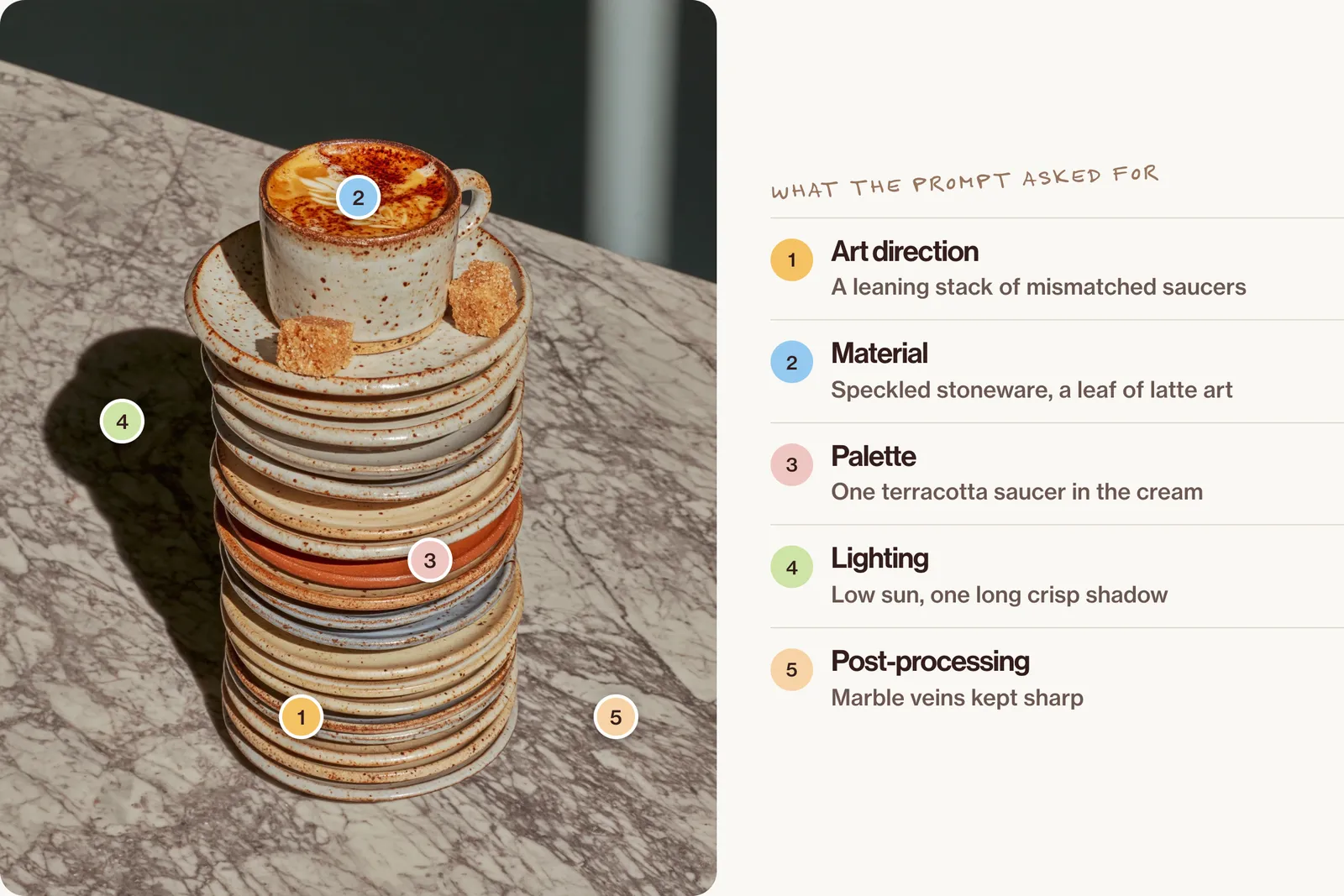
Each line of the prompt shows up somewhere in the picture. Remove one and that part goes back to the model's default.
Image prompt template (copy and fill in)
Creative direction: [what the image is for and who will see it]. Art direction: [what happens in the frame, where things are, what the subject is doing]. Material: [the subject: what it is made of, its colours, textures and details; for a person, their age, features, skin and clothes]. Palette: [three or four colours]. Lighting: [one main light, where it comes from, how soft or hard]. Photography: [lens or camera, distance, height, framing, aspect ratio, what is in focus]. Mood: [two or three words]. Post-processing: [the finish: colour, contrast, grain, what not to retouch].This works in any current model. For tool-specific tips, see Nano Banana prompts and Higgsfield prompts.
AI image prompt examples by use
Every example below was written for this guide.
Portrait: an editorial headshot
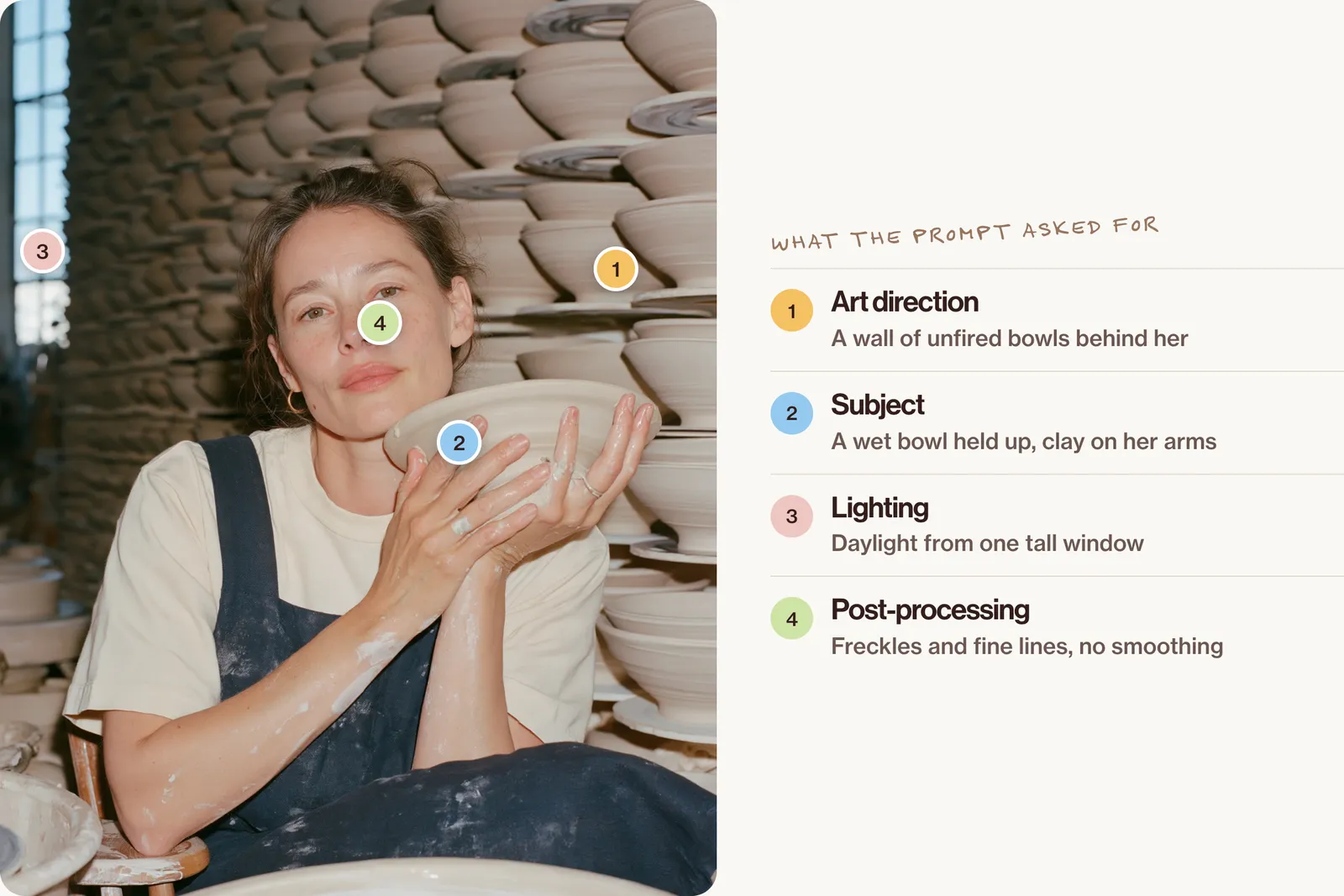
Creative direction: a portrait of a ceramicist for her studio's About page that feels like an editorial, not a headshot. Art direction: she sits on a wooden stool in front of a floor-to-ceiling wall of unfired bowls stacked in neat columns, holding one freshly thrown wet bowl up beside her face with both hands, clay running down her wrists. Subject: a woman in her late forties with grey-streaked dark hair tied back, clay dust on her forearms, a faded indigo linen apron over a cream T-shirt. Palette: raw clay, chalky off-white and one deep indigo. Lighting: soft daylight from one tall window on the left, the wall of bowls falling gradually into shade. Photography: 85mm lens at f/2.8, eye level, framed from the waist up, slightly off-centre, focus on her near eye and the wet bowl. Mood: calm, capable, quietly proud. Post-processing: natural skin with visible pores and fine lines, neutral white balance, light film grain, no smoothing.To change it: swap the profession and its one striking prop, keep the light and the skin line.
Portrait: outdoor, at dawn
Creative direction: a spring flyer for a running club that feels like a sports campaign, not a stock photo. Art direction: a young man mid-stride on an empty athletics track at dawn, a long orange ribbon tied to his wrist streaming behind him in a perfect curve, the lane lines leading into the distance. Subject: a man in his mid-twenties with short curly hair damp at the hairline, a light-grey half-zip running top with a small sweat patch at the collar, bright orange running shoes. Palette: brick-red track, white lines, pale dawn sky and the orange of the ribbon and shoes. Lighting: low sun just above the horizon behind him, a warm rim light on his hair and shoulders, soft fill from the sky. Photography: 70mm lens at f/4, low angle from the inside lane, full figure off-centre, 4:5. Mood: light, energised, free. Post-processing: true-to-life colour, gentle contrast, fine grain, no beauty retouching.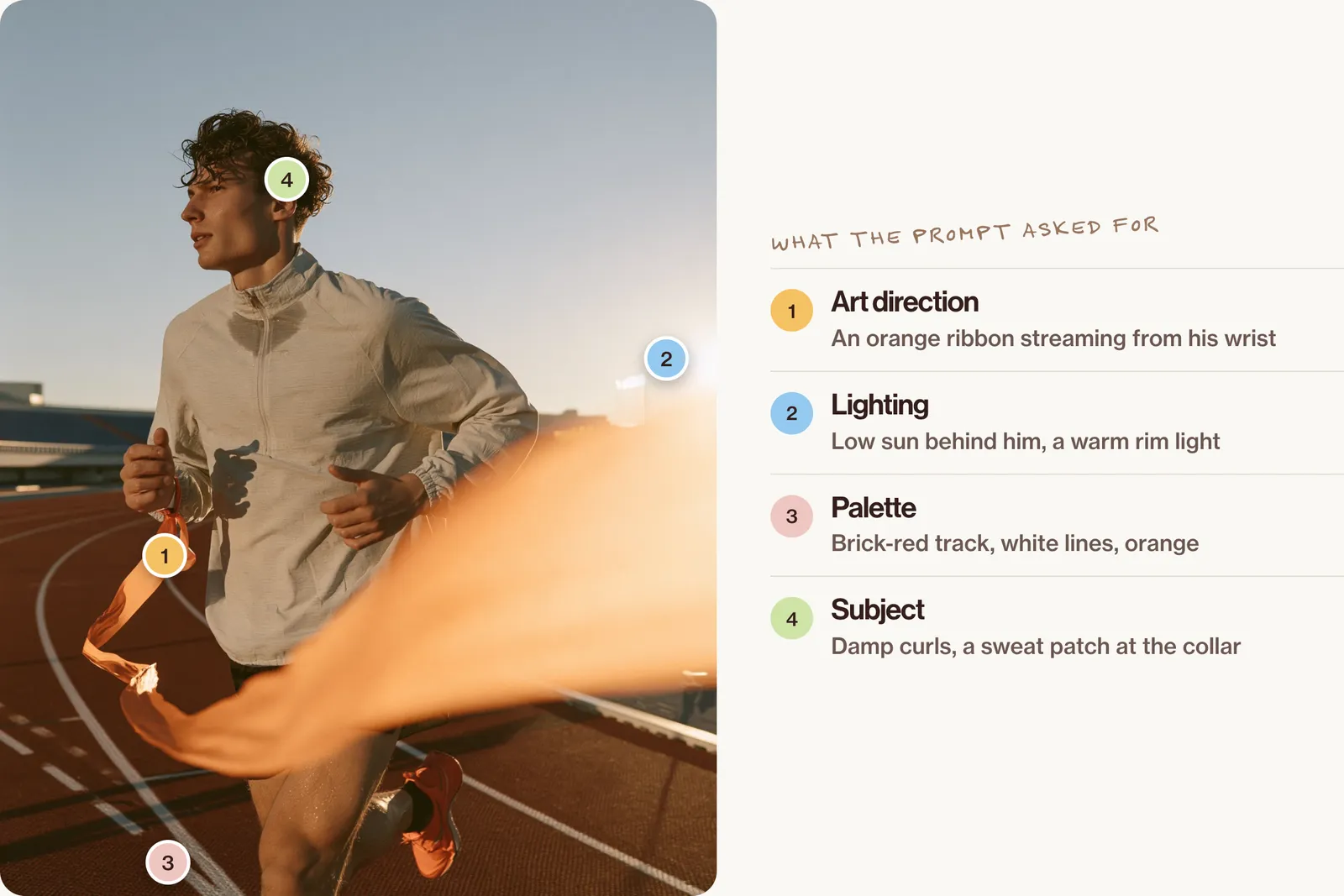
Product: clean hero
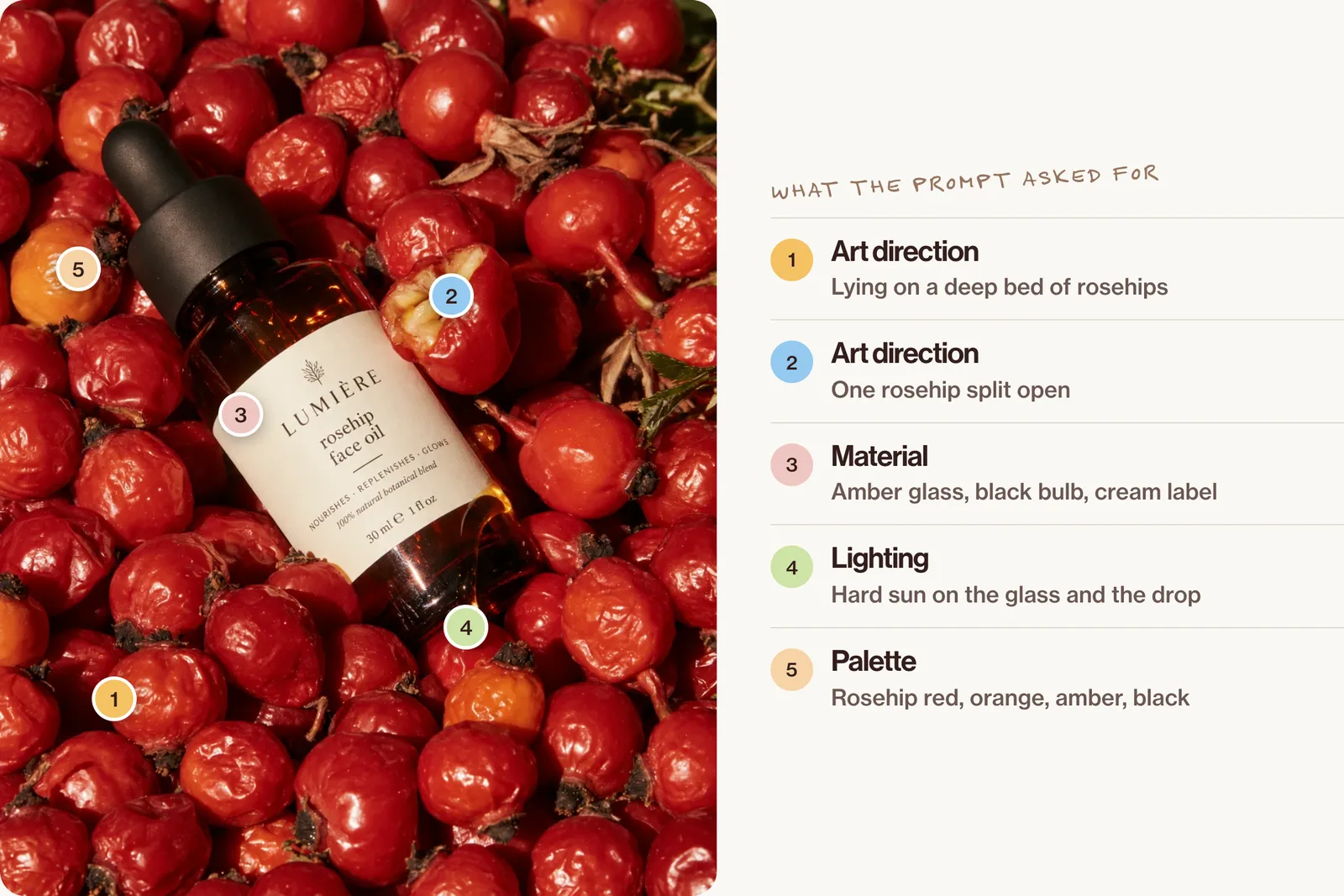
Creative direction: a bold hero image for a small skincare brand's rosehip face oil, for the top of its product page. Art direction: the bottle lying on its side, half buried in a deep bed of hundreds of glossy red rosehips, shot from directly above, one rosehip split open beside it showing its seeds, a single golden drop running down the glass. Product material: a 30 ml amber glass dropper bottle with a matte black rubber bulb and a plain cream paper label printed with small black serif text. Palette: rosehip red, deep orange, amber and black only. Lighting: hard midday sun from the upper left, crisp shadows between the berries, bright highlights on the glass and the drop. Photography: straight down from above, 100mm lens, 4:5 portrait, the label sharp and readable. Mood: rich, natural, confident. Post-processing: saturated but true colour, crisp detail, no glow.For a real product, start from a photo of it instead; see AI product photography.
Product: a playful moment
Creative direction: a playful hero image for a small-batch granola brand's social feed. Art direction: the open pouch floating in mid-air above a white bowl of yoghurt, a frozen arc of golden granola clusters and blueberries pouring out of it into the bowl, a few clusters suspended mid-fall, against a sky-blue background. Product material: a matte kraft-paper stand-up pouch with a resealable top and a simple one-colour green label facing the camera. Palette: sky blue, oat gold, kraft brown, deep green and blueberry. Lighting: bright, hard studio light from the upper right, crisp shadows of the falling clusters on the bowl. Photography: straight-on at bowl height, 50mm lens, 4:5 portrait, everything sharp, the pour frozen mid-air. Mood: joyful, generous, a little cheeky. Post-processing: clean, saturated but true colour, crisp detail, no glow.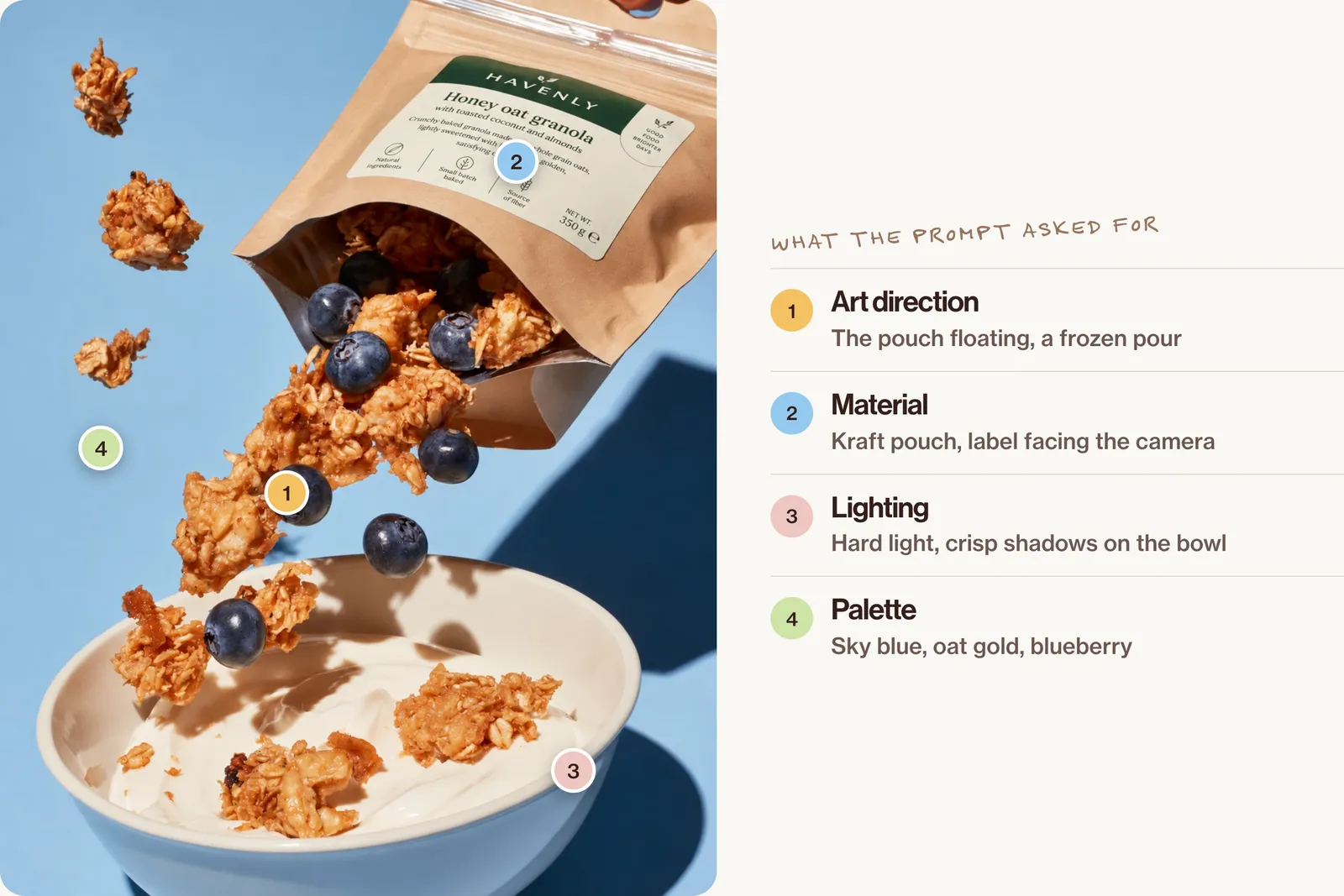
Lifestyle
Creative direction: a lifestyle frame for a reading-light brand that feels like a still from a film. Art direction: a single armchair alone in the middle of a vast, empty concrete room at dusk, a woman curled in it reading a paperback, the lamp beside her the only light, its warm pool drawing a circle on the floor around the chair; floor-to-ceiling windows behind her turning deep blue. Subject: a woman in her thirties in an oversized oatmeal cardigan, socked feet tucked under her, hair loosely clipped up. Palette: warm lamplight, oatmeal, raw concrete grey and dusk blue. Lighting: the lamp as the only light, warm and pooled on the page, her hands and the floor; cool blue dusk from the windows. Photography: 35mm lens at f/2.8, wide, from across the room at seated height, the chair small and centred in the frame, the lamp and her hands in focus. Mood: cosy, private, cinematic. Post-processing: gentle grain, mixed colour temperature kept as it is, deep but soft shadows, no added glow.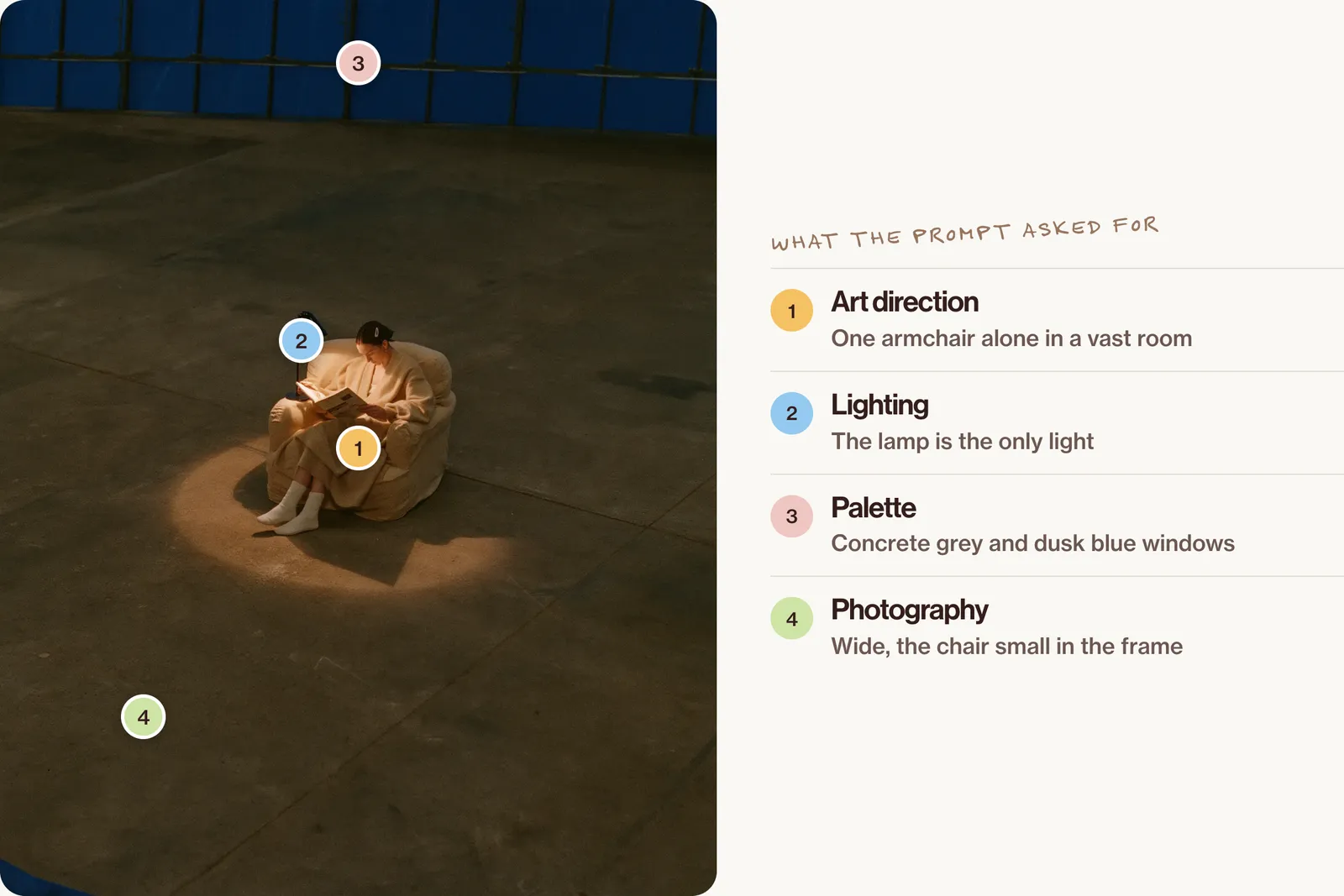
UGC phone shot: mirror selfie with a product
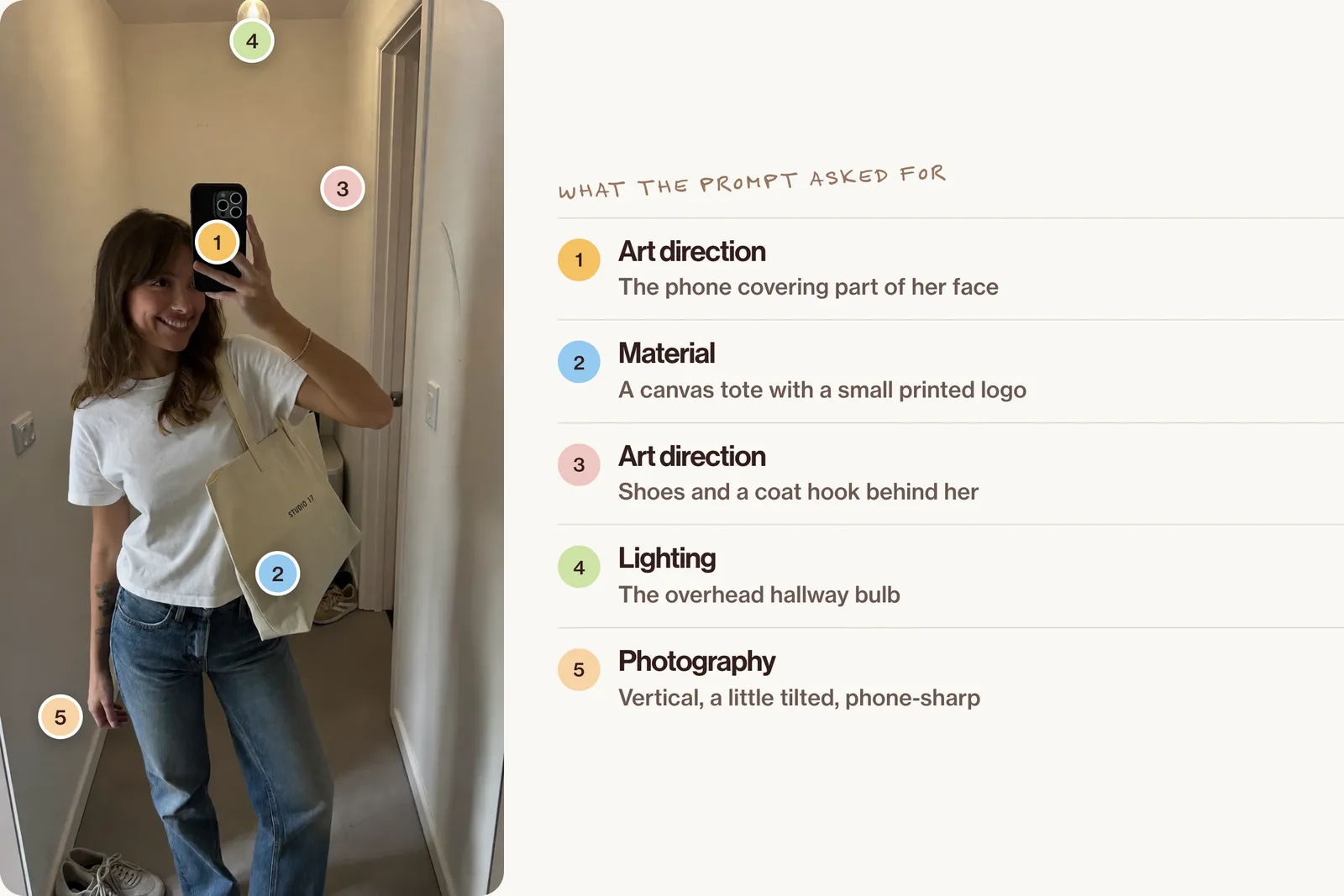
Creative direction: a believable phone photo a customer might post after receiving a tote bag, for a brand's "how you wear it" story. Art direction: a mirror selfie in a slightly messy hallway, the phone covering part of her face, the tote on her shoulder, shoes and a coat hook visible behind her. Subject: a woman in her early twenties in a white T-shirt, straight-leg jeans and trainers, a natural-canvas tote with a small black printed logo on her right shoulder. Palette: off-white, denim blue, natural canvas, a little hallway clutter colour. Lighting: the overhead hallway bulb plus daylight from an open door, slightly uneven. Photography: shot on a smartphone's main camera in the mirror, vertical 9:16, a little tilted, everything in focus, slight phone-camera noise in the shadows. Mood: casual, pleased, unstaged. Post-processing: straight from the phone, no filter, a smudge on the mirror left in.AI people in ads may need labelling; see AI UGC ads for how to do this honestly.
UGC phone shot: flash at night
Creative direction: a fun night-out photo for a canned-drink brand, the kind a friend takes on the way to dinner. Art direction: two friends laughing on a city pavement at night, one holding the can towards the camera, a lit shop window and a parked scooter behind them. Subject: two women in their late twenties in leather jackets, one with a short bob, one with braids; the can is matte coral aluminium with a small white wordmark. Palette: coral, black, warm streetlight orange. Lighting: direct on-phone flash, hard and bright on faces and the can, the background falling into dark ambient light. Photography: smartphone flash snapshot, vertical 4:5, slightly off-centre, a touch of motion blur at the edges. Mood: spontaneous, loud, happy. Post-processing: flash-hot highlights left as they are, no smoothing, natural skin shine.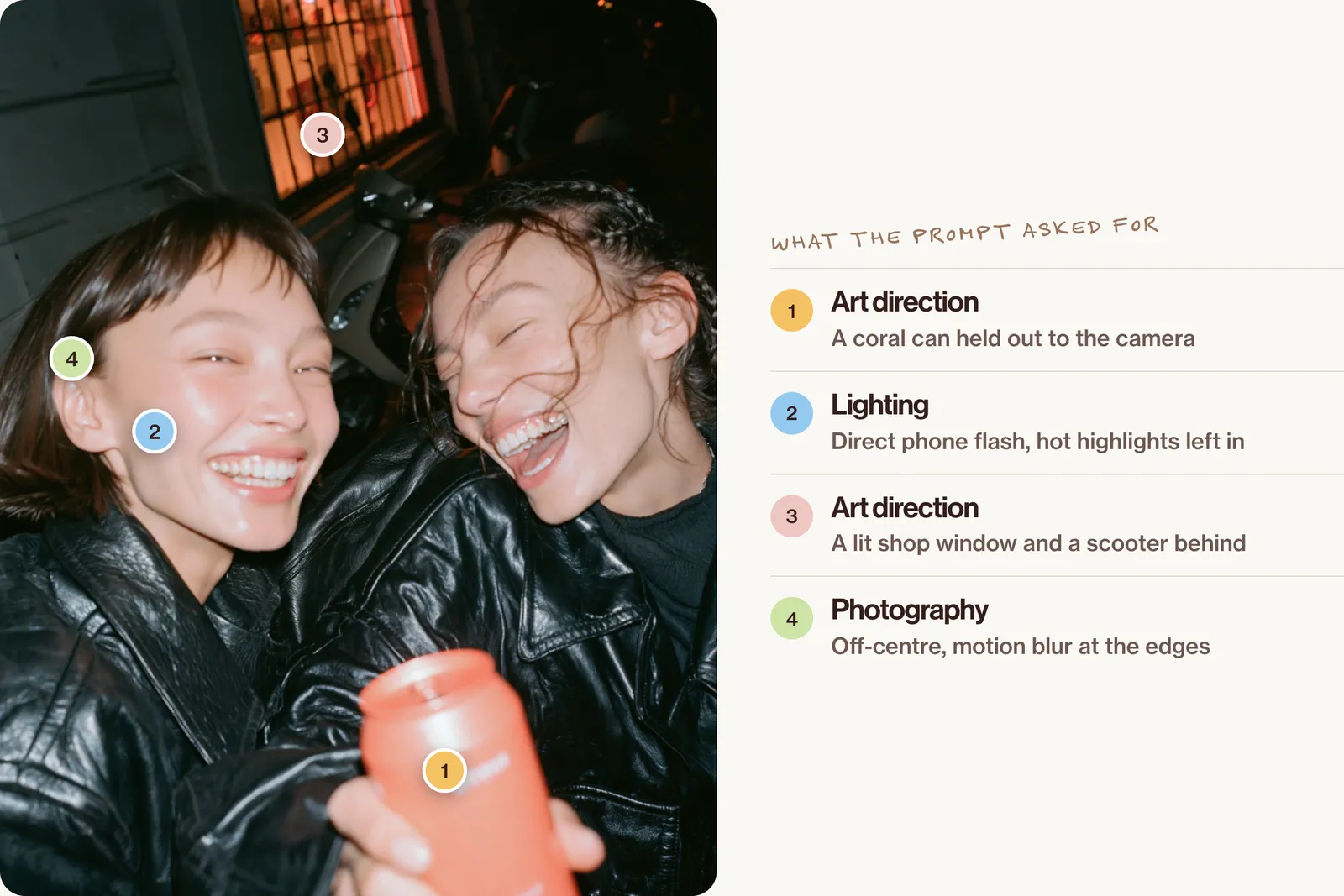
Editorial
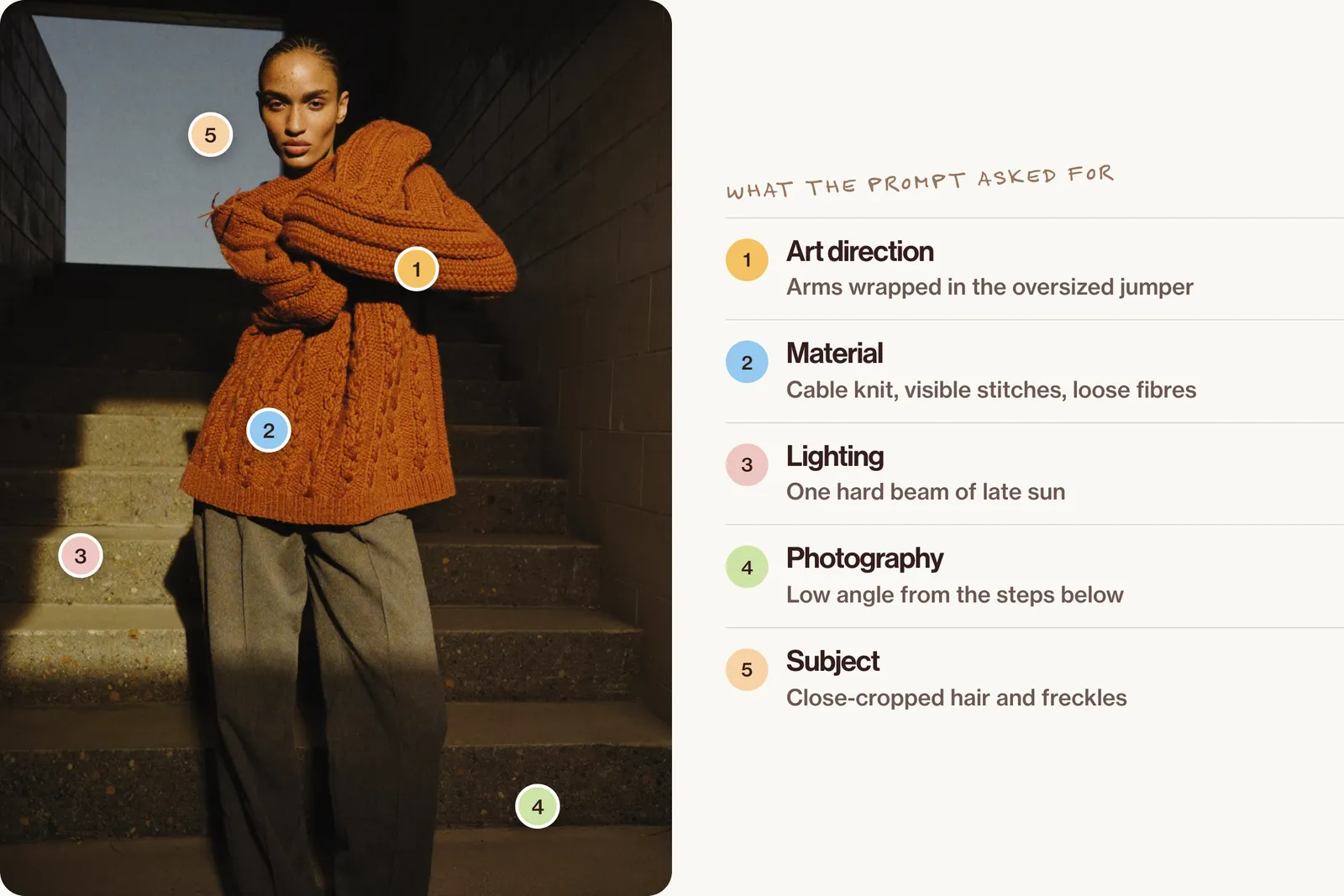
Creative direction: a fashion-editorial image for a knitwear label's autumn lookbook that treats the jumper like sculpture. Art direction: a model stands in an empty concrete stairwell, arms wrapped around herself, one shoulder of an oversized chunky jumper slipping, a single long shadow across the steps. Subject: a woman with close-cropped hair and freckles wearing a rust-orange cable-knit wool jumper with visible stitches and a few loose fibres, grey wide trousers. Palette: rust, concrete grey and black. Lighting: one hard beam of late sun through a high window, sharp-edged light and deep shadow. Photography: medium-format feel, 80mm lens, low angle from three steps below, full figure off-centre with negative space on the right. Mood: still, strong, slightly austere. Post-processing: rich but true colour, deep blacks, fine grain, wool texture crisp.For keeping real garments accurate on AI models, see AI models for your clothing brand.
Prompts for realistic images: five habits that matter more than any keyword
- Name the light source. "Window on the left" beats "beautiful lighting" every time.
- Describe a camera situation, not a camera brand. Where the camera stands and how far away tells the model more than a model number.
- Describe materials. Linen, brushed steel, chipped enamel, uneven glaze: texture is what makes things look real.
- Ask for ordinary imperfection. A crease, a crumb, a stray hair.
- Commit to one look. Flash snapshot or soft film portrait, not both.
The full checklist is in how to make AI photos look real.
When to stop writing and start editing
Once an image is about 80% right, stop rewriting the prompt. Edit instead: "change X, keep everything else exactly the same". It is faster and you don't lose what already works. Both Nano Banana and ChatGPT are good at this.
Common prompt mistakes
| Mistake | Fix |
|---|---|
| Quality words ("8K, masterpiece") | Describe the finish: "fine grain, soft contrast" |
| No light source | Name one light and where it comes from |
| Too many colours | Pick three or four |
| "No cars, no people" | Describe what is there: "an empty street at dawn" |
| Two looks at once | Commit to one camera and one finish |
| Rewriting everything after each try | Change one line at a time |
FAQ
What is the best image prompt structure?
Start with what the image is for, then what happens in the frame, the subject, palette, light, camera, mood and finish. The order matters less than deciding each of them.
How long should an image prompt be?
Long enough to make those decisions, usually four to eight sentences. A short prompt is fine for exploring; a full one is better for a result you need to repeat.
Do words like "8K" or "photorealistic" help?
Not really. Resolution is a setting, not a word, and quality words tend to push images towards a glossy, rendered look.
Do negative prompts still work?
Many current tools have no negative prompt field. Describe what you want instead of what you don't.
Go further
You've got the eight decisions. Inside New Creator Club you learn to use them across the leading AI tools, for products, people, ads and video, and you keep up as those tools change every month. Start creating.
Keep reading
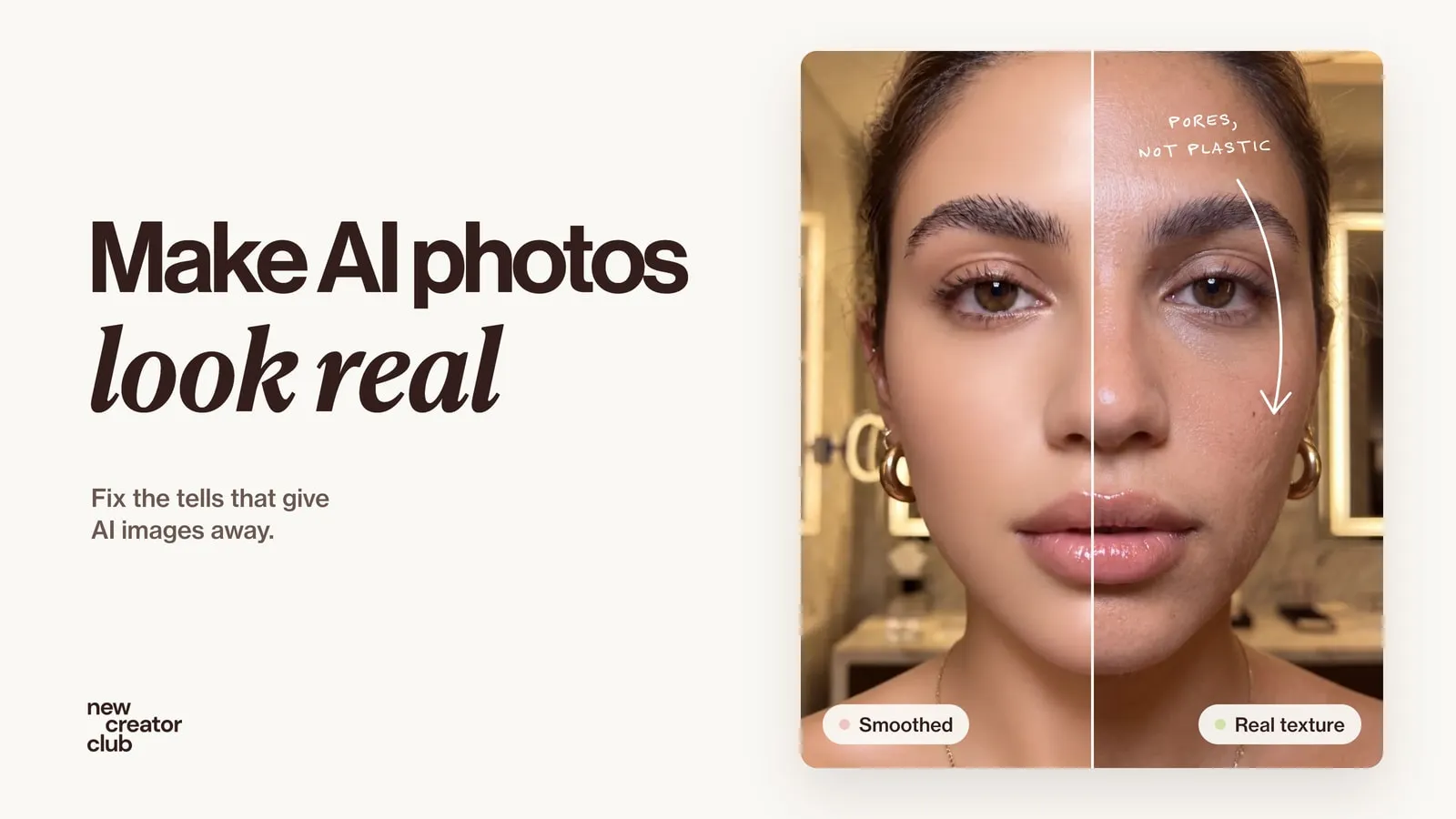
How to make AI photos look real
How to make AI photos look real: why they look fake, and the exact prompt change that fixes each tell, from plastic skin to impossible light.
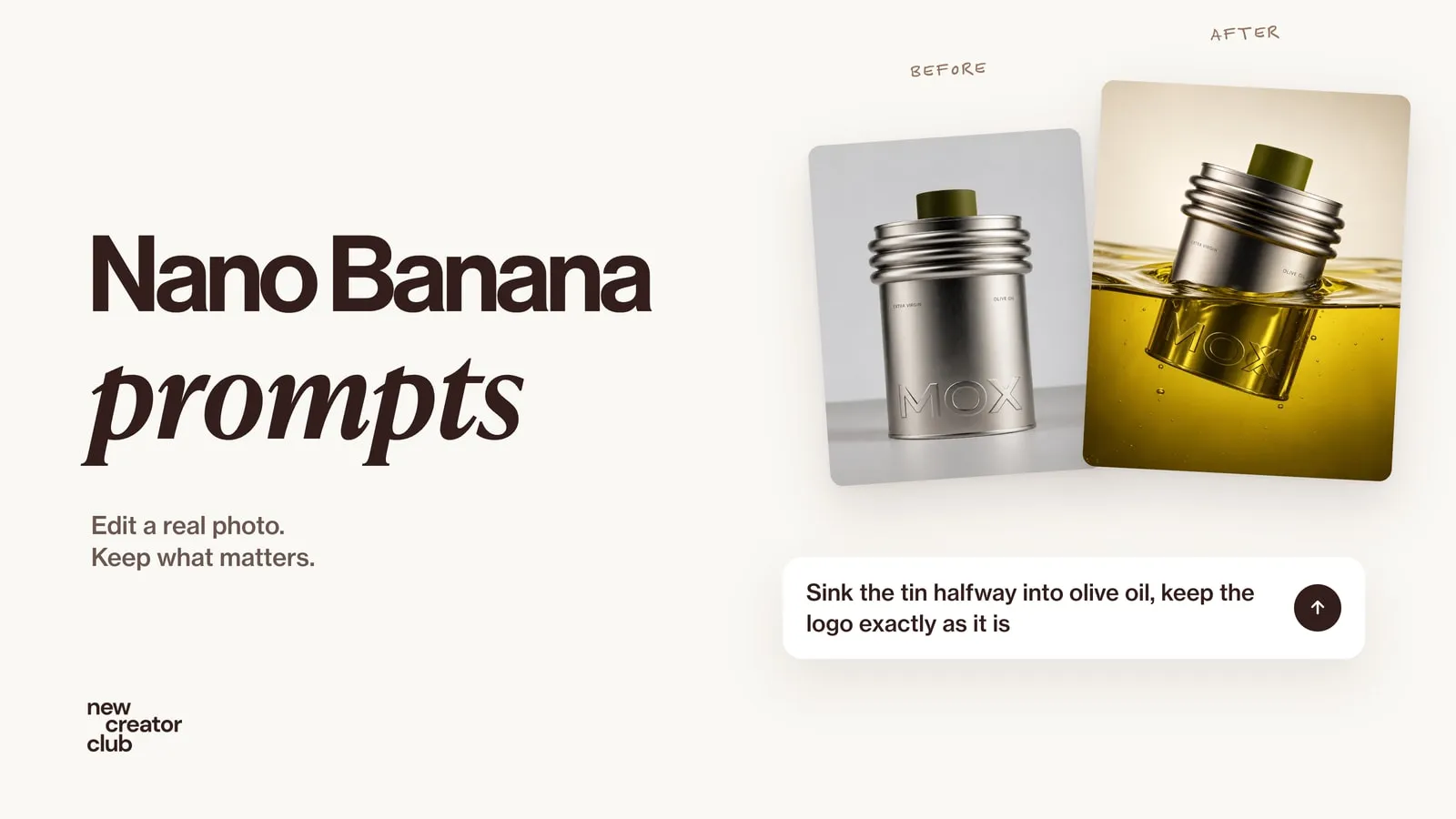
Nano Banana prompts for editing real photos
Nano Banana prompts for editing real photos: swap backgrounds, relight, add hands and keep products and faces consistent, plus fixes for when edits go wrong.
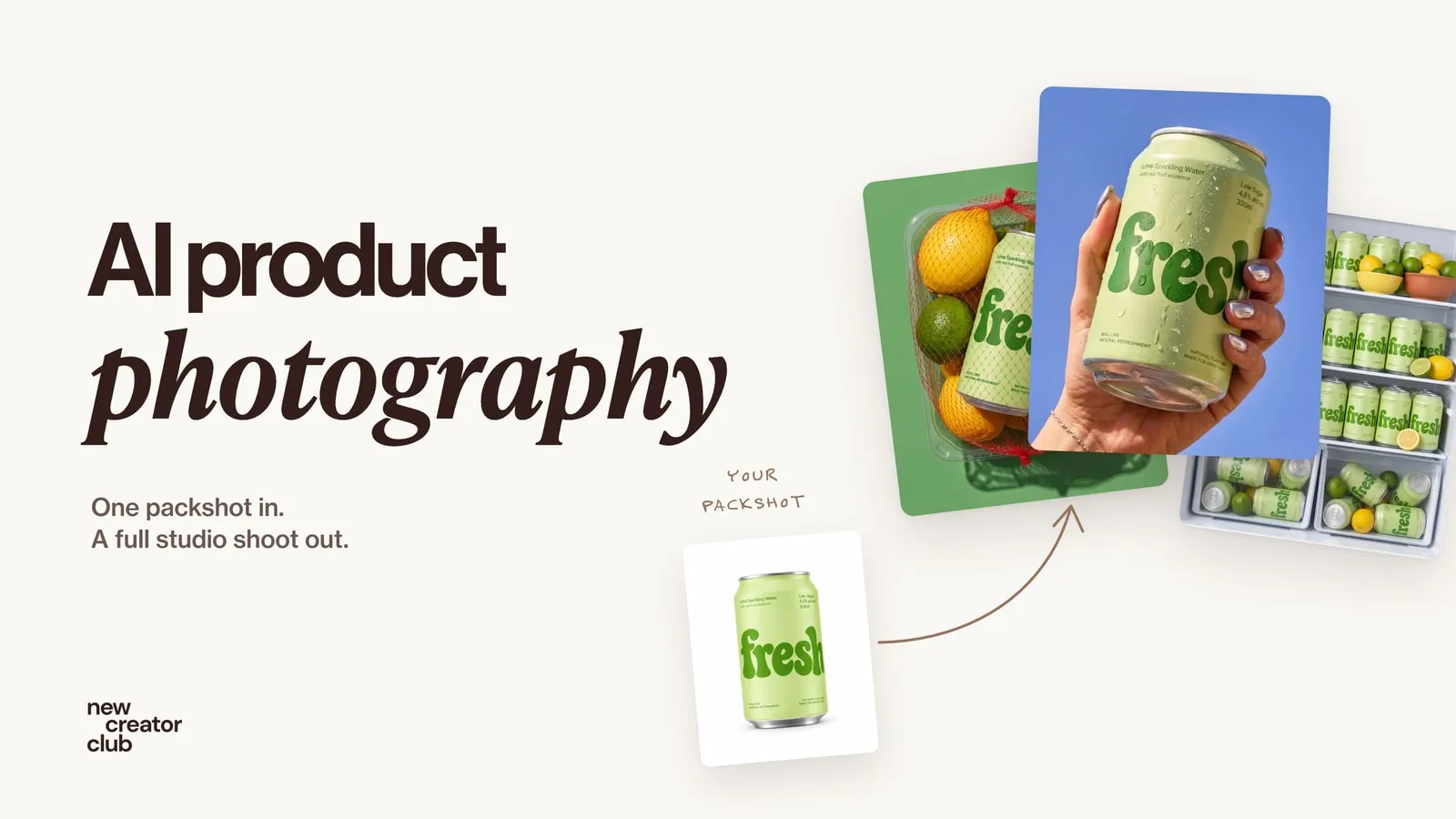
AI product photography: one packshot, a full studio shoot
AI product photography from one packshot: a full studio shoot that keeps the label and colours true, with a worked example, the prompts and the checks.